Showing posts with label C02: 1952-54. Show all posts

26 February 2025

Feedback on C02 Zonals

At the start of the previous post, Feedback on C10 Zonals (February 2025), I wrote,
During the six months of inactivity mentioned in [a] recent post, I received a number of relevant comments about my pages, some of them requiring non-trivial updates to those pages.

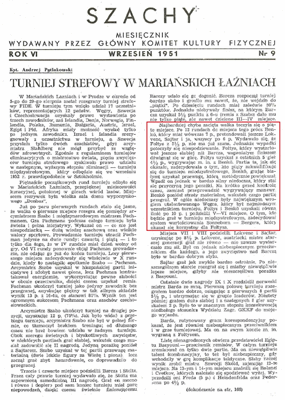
A few months after the comment on the 'C10 Zonals', I received an email from Przemek Jahr [PJ; of szachypolskie.pl] titled, 'C02 Qualifiers, 3* EUR Marianske Lazne 1951-08'. That title echoes a page titled, (C02) 1951-1954 Zonal Cycle (m-w.com) plus its corresponding 'Qualifiers' page. The email informed,

According to the report of Andrzej Pytlakowski, a participant of the zonal tournament, published in "Szachy" 9/1951, a play-off for 5th place was not planned and Jan Foltys took this place due to the better Sonneborn-Berger system.

The same email included an attachment showing the cover page of the referenced Polish chess magazine.

The paragraph outlined in red translates to:-

The most fierce battle was probably for fifth place. After 12 rounds, the contenders for this place were, apart from Benko, who had 7 points at the time. Lokvenc, Sajtar and I, all with 6 points each, also claimed. It seemed that Foltys with 5 1/2 points had no chance. However, events took an unexpected turn.

Foltys, who started even worse than Barcza, pulled himself up with a magnificent finish. Foltys gained 4 1/2 points from the last 5 games, winning against Benko among others. The game, as it turned out, decided who would qualify fifth for the interzonal tournament. Benko, playing white, gained an advantage, which he methodically increased. However, he ran into a very serious time deficit, which became the cause of his defeat.

Shortly before the time control, instead of carrying out a winning maneuver, Benko suffered material losses, as a result of which he lost the game. In general, time deficits were the greatest enemy of the talented Hungarian, who was the youngest participant in the tournament.

Foltys and Benko obtained an equal number of 10 points each and shared 5th-6th place. The Sonneborn-Berger evaluation system, which turned out to be beneficial for Foltys, decided who would play in the interzonal tournament.

The rest of the page is undoubtedly equally useful and I might tackle its translation some day.

11 May 2022

A Giant Among GMs

Earlier this week, in Yuri Averbakh, 1922-2022 (chess.com), Peter Doggers reported,
GM Yuri Averbakh, the world’s oldest grandmaster, a trainer, international arbiter, chess composer, endgame theoretician, writer, historian, honorary member of FIDE, and the last living participant of the famous Zurich 1953 Candidates Tournament, has passed away, three months after turning 100. His death has been confirmed by the Russian Chess Federation and FIDE. Averbakh was one of the few strong players who managed to simultaneously reach significant heights in chess theory, literature, journalism, history, and chess politics.

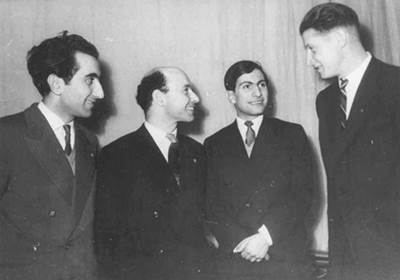
Of the dozen photos of GM Averbakh in my eBay photo archive, this was my favorite. From an eBay auction in February 2012:-

The description informed,

Original Soviet chess press photo. The 26th Championship of USSR in Tbilisi 1959. Grandmasters from left to right: Tigran Petrosian, David Bronstein, Mikhail Tal, Yuri Averbakh.

The photo pictures a former World Championship challenger (Bronstein) and two future World Champions (Tal, Petrosian). GM Averbakh competed in the 1952 Saltsjobaden Interzonal (5-8th/21), the 1953 Zurich Candidates (10th-11th/15), and the 1958 Portoroz Interzonal (7-11th/21) a half point behind the group that qualified for the 1959 Yugoslavia Candidates (all links m-w.com).

Averbakh has figured many times on this blog, as well as on my main blog, e.g. in these related posts:-

Many of the posts on my main blog were related to his contributions to endgame theory. This post is all Averbakh:-

In another post on that blog, Friendly Chess Players (July 2013), I mentioned,

Near the end of the book ['Centre-Stage and Behind the Scenes: A Personal Memoir'], GM Averbakh divides great players into six groups. Here are quotes from Averbakh describing each group [...]

Another obituary from this week, Yuri Averbakh, Chess’s First Centenarian Grandmaster, Dies at 100 (nytimes.com), by the NYT's top chess writer, Dylan Loeb McClain, referenced the same categories:-

Though Mr. Averbakh was talented, he said he knew he lacked the necessary qualities to become a world champion. In his autobiography, he wrote that great players fall into six categories: killers, fighters, sportsmen, people who like to play games, artists and explorers. All of the world champions came from the first four groups, he said. He put himself in the sixth category -- that of an explorer.

GM Averbakh was a World Champion chess explorer, possibly the greatest ever. Who else comes close?

18 March 2015

More Berman Memoirs

Continuing with Early FIDE Zonals, I added more clippings from Marcel Berman's French-language memoirs published 50-60 years ago in FIDE Review. The zonal pages I updated were:-

It's not always obvious which actions from which FIDE Congress took effect in which cycle, so I might rearrange the material if I determine that the chronological sequence is misleading.

31 July 2013

Averbakh on the World Championship

In yesterday's post on my main blog, Friendly Chess Players, I introduced Averbakh's 'Centre-Stage and Behind the Scenes: A Personal Memoir'. The book is filled with stories about the World Championship, some of them new to me, many of them in more detail than I've seen before. Here's a list, each entry starting with its first page number in the book.

059 : 1950 CT
063 : 1951 19th USSR Chp semifinal (pre-zonal)
064 : ---- Pen portraits (A)
070 : 1951 19th USSR Chp (zonal)
071 : 1952 IZ
078 : 1953 CT
092 : 1955 22nd USSR Chp (zonal)
100 : ---- Sparring partner to MB
108 : 1958 25th USSR Chp (zonal)
110 : 1958 IZ
112 : ---- Early rules for WCC
120 : 1959 CT
129 : 1962 CT
147 : 1968 IZ playoff
154 : 1971 CM: TP-VK, RF-TP
157 : ---- Baturinsky
163 : 1972 WC: RF-BS
164 : 1963 VS & zonal
166 : 1974 CM: TP-LP, VK-TP
169 : 1977 CM: VK-TP
171 : 1974 FIDE Congress: AK-RF
175 : 1974 CM: AK-VK
178 : 1976 VK defection
185 : 1978 WC: AK-VK, Sevastianov
190 : 1982 IZ
193 : 1972 WC: RF-BS, Euwe
194 : 1982 FIDE President Campomanes
199 : 1982 CM: VS-RH, VS-ZR, GK-VK
214 : 1984 WC: AK-GK I
220 : 1985 WC: GK-AK II
221 : 1986 WC: GK-AK III
223 : 1987 FIDE Presidential election, GMA
223 : 1987 WC: GK-AK IV
224 : 1988 USSR Chp, GK-AK playoff
227 : 1988 USSR vs. World charity match
229 : 1990 Women's CT, Krogius
232 : 1972 Graz, Huebner - Rogoff (B)
233 : 1990 FIDE Presidential election
235 : 1987 GMA
236 : ---- Chess psychology (C)
240 : 1982 OL: Manila
242 : 1993 Schism, PCA, GK-NS, AK-JT
247 : 1994 OL: Salonika -> Moscow
250 : 1994 FIDE Presidential election
251 : 1995 FIDE Congress, Paris, Ilyumzhinov

IZ: Interzonal
CT: Candidate Tournament
CM: Candidate Match
WC: World Championship
OL: Olympiad (esp. Congress++)

AK: Karpov, BS: Spassky, GK: Kasparov, JT: Timman, LP: Portisch, MB: Botvinnik, NS: Short, RF: Fischer, RH: Huebner, TP: Petrosian, VK: Korchnoi, VS: Smyslov, ZR: Ribli

(A) Zubarev, Blumenfeld, Duz-Khotimirsky, Rabinovich, Verlinsky, Romanovsky
(B) A little known story about the future IMF Chief Economist; nothing to do with WC
(C) Incl. six categories of player as in 'Friendly Chess Players'

Although Averbakh's book deserves a review on my blog, this summary will have to do for now.

15 August 2012

Fortunate with His Temperament

Fischer (1943-2008), Filip (1928-2009), Smyslov (1921–2010), Larsen (1935–2010), now Gligoric (1923–2012); one by one the World Championship contenders of the mid-20th century are leaving us: Svetozar Gligoric, legend of the King's Indian, dies at 89, (Chessvibes.com, 14 August 2012).

The first chapter of Gligoric's I Play against Pieces (Batsford 2002) is autobiographical, with several passages relating to his struggles for the World Championship. A sample:-

An episode from my 'comeback' in 1967: After the Interzonal in Portoroz 1958 I gave the impression of being one of favourites in the Candidates tournament 1959 of 8 participants, and I disappointed my audience when I finished 5th-6th in the company of a young grandmaster by name of Bobby Fischer... I continued my 'going down' in the Interzonals at Stockholm 1962 and Amsterdam 1964, failing twice to qualify for the Candidates stage. When I went to Sousse in 1967, nothing spectacular was to be expected from me.

At that time, I had some new ideas for a safe opening repertoire and intended, as usual, to rely on my intuition during play. My plan was not to lose a single game and to gain the minimum number of wins necessary for qualification -- and that I thought I could do.

I was 44 and it surprised me when my new second, young Velimirovic, treated me like a novice in international chess. He forced me to break my regular habits and to spend 2-3 hours each morning in preparation for the game in the afternoon. It was like a prophecy of how chess players behave nowadays, where preparation can offer a 90% guarantee of success.

Gligoric finished tied for 2nd-4th (+7-0=14) with Korchnoi and Geller (1967 Sousse Interzonal Tournament). The following year he played Tal in the first round of the Candidate matches.

My tactics were like balancing on the brink of a threatening abyss -- if I lost a single game. It did happen in my next match with Tal who, in 1968 said that for several reasons Belgrade as a playing site was a handicap to me. I was leading after five games and both Tal and his second Koblentz believed that I was going to win the match.

Then in the 6th game, stupidly irritated by journalistic comments on the 'monotony of our duel', I shocked myself with a sudden decision at the board to make a 3rd move as White for which I was unprepared. After that defeat I collapsed. If one could explain it -- I must have been tired of the situation with no tranquillity. Among other things, the playing hall was across the street from where I lived downtown with my wife and this was like an open invitation to benevolent visitors to frequent our place. However I was fortunate with my temperament and did not regret one bit my lost chance.

Not only was Gligoric a world class player, he was also a world class journalist and a world class arbiter. The man who declared himself to be 'fortunate with my temperament' is already in the books as one of the greatest.

24 March 2010

Botvinnik Rules

Throughout 'My Great Predecessors II', Kasparov was critical of limitations placed on Soviet players in the qualifying cycles of the 1950s and 1960s. He wrote the following in the chapter on Botvinnnik (p.186; I've left out details about individual circumstances).
[In 1958] there began a spell of bad luck and vexing failures in Bronstein's career. The cause of this was largely the Botvinnik initiated limit on the representatives from one country (i.e. the USSR) in the Candidates tournaments: not more than five out of eight were allowed.

In the Interzonal tournament in Portoroz 1958 there were six qualifiers, but the four Soviet grandmasters were fighting for only three places (since Smyslov and Keres were already in the list of Candidates), and willingly or not they were forced to play keeping an eye on one another. Both [Bronstein] and Averbakh missed out by half a step.

He was to suffer an even crueller stroke of fate at the Interzonal in Amsterdam 1964, where five Soviet grandmasters were fighting for the same three places. Another to suffer was Stein, who fell victim to the 'Botvinnik rule' for the second consecutive time.

It was effectively on account of this unjust restriction that two such splendid players as Bronstein and Stein missed out on the battle for the World Championship. Their replacements in the Candidates events were not of equivalent strength and it is clear that, with their participation, things at the top of chess could have turned out differently.

Alas, few now remember these human dramas. But meanwhile they reflected the unnatural situation that existed in chess in the 1950s and 1960s, when many of the best grandmasters, occupying most of the places in the world's top 30, had no opportunity to participate fully in the World Championship qualifying cycle -- for the only reason that they were Soviets.

Some will retort: but with this limit, fighting spirit was strengthened and only the very best made it to the top -- that is by the laws of Darwinism, the strongest survived. But just think how much nervous energy it cost these world-class stars to battle among themselves for the right to squeeze through the eye of a needle. And how it must have been to recognize that you are stronger and have occupied a higher place, but it is another player who will go through. Were not these unhealed spiritual wounds one of the causes of the untimely death of Leonid Stein?

(That last sentence deserves special attention, but it takes me too far from the subject at hand; this is not the right place to address it.) In the same chapter (p.215) Kasparov linked the 'Botvinnik rule' with the right to a return match.

In 1956, soon after Smyslov's second victory in the Candidates tournament, an event occurred that was to have a strong influence on the entire modern history of chess: FIDE granted the World Champion the right to a return match. The decision was adopted together with the aforementioned 'Botvinnik rule', and also not without the participation of [Botvinnik] (I should remind you that his friend Ragozin was a FIDE Vice-President).

Although earlier, in the late 1940s, in his plan for the contesting of the World Championship, he had rejected the idea of the return match, since 'it's organization would disturb the periodicity of the system, and in the interests of chess this must not be allowed', and he had gained the right for a defeated champion to play a match-tournament with the champion and the challenger three years later (this FIDE rule operated in the 1951 and 1954 matches).

The inescapable conclusion is that Botvinnik was behind both the limitation on Soviet players and the return match because these rules gave him better chances to retain his World Championship title. While I have no particular argument with this conclusion, I still wonder to what extent the 'Botvinnik rule' was a consequence of other federations' fears of Soviet collusion, as described in Collusion and Consequences. Perhaps it wasn't really a 'Botvinnik rule', but rather Botvinnik seeing personal advantage in a rule favored by the other chess federations.

In 'Predecessors IV' Kasparov dismissed the idea that Soviet collusion was responsible for Fischer's mediocre showing at Curacao in 1962. 'At that moment Bobby was not yet ready to win such a tournament -- irrespective of whether or not there was such a pact. Averbakh: "If Fischer could have beaten the Soviet grandmasters, as was to happen later in the early 1970s, no amount of draws would have been able to stop him."' (p.300). In other words, to win against collusion, a player had to be significantly better than the Soviet opposition. Tightly contested tournaments would always favor the Soviet bloc.

FIDE implemented matches to eliminate collusion in the Candidate tournaments. Was the primary objective of the earlier 'Botvinnik rule' to eliminate collusion in Interzonals rather than to favor Botvinnik?

10 March 2010

The Threat of Collusion

In a previous post on the 1952 Interzonal, Collusion and Consequences, I speculated about qualification into the subsequent Candidates event: 'I'm not sure why Reshevsky and Euwe were seeded into the 1953 Candidates Tournament, although it makes sense that it was because of their participation in the 1948 FIDE Title Tournament, won by Botvinnik.' After a little more investigation, I determined that this was indeed the case and then documented the various reasons for qualification on the pages for that cycle: 1952 Saltsjobaden Interzonal and 1953 Zurich Candidates.

As for any collusion in the 1953 Candidates Tournament, I found the following in Chess Review, November 1953 (p.323):

[Reshevsky] entered the tournament not at all certain that the nine man Russian "syndicate" would be overly concerned with "bourgeois" standards of sportsmanship. At Saltsjobaden there had been undeniable collusion by the Russians in a move to freeze out Western competitors. Might not the same tactics be repeated at some critical stage in the present struggle if it became expedient to throw collective support to the Soviet candidate whose prospects had crystallized above those of his fellow Russians? Regarding this possibility, the Australian Chess World remarked in a pre-tournament issue that "we fear the Russians would put patriotism above the canons of sport, as at Saltsjobaden, and make things a bit easier for the top Russian."

While Chess Review has no evidence that such collusion was either planned or practiced in Switzerland, the ever-present threat operated as a mental hazard that could not but adversely affect the play of the Western group. An indication of the peculiar Russian mentality on this point is seen in the intransigent attitude of Ragozin, official spokesman for the Russian delegation, during an interview with the American journalist and master, George Koltanowski. When George started to ask a question beginning, "If a non-Russian were to win this tournament..." Ragozin brusquely interrupted: "Nyet! Never! Impossible!"

Why players of the calibre of Reshevsky, Najdorf, Gligoric and so forth should be ruled out summarily is difficult to see, even if we grant the undoubted capabilities of the Russian stars. Was Ragozin merely voicing a personal opinion as to the probable outcome? Or was he expounding an official a priori dogma that no non-Communist will ever be alowed to win a challengers' tournament if the Russians, by hook or by crook, can possibly prevent it?

Another ugly (and rather astonishing) blot on the tourney, according to information received from one of Chess Review's observers on the scene was the unabashed consultation by the Russian contingent -- "flagrant coaching from the sidelines ... and tips passed from one Russian player to another during games".

Despite the lack of 'evidence that such collusion was either planned or practiced', the threat was as strong as the execution, at least for the editors of Chess Review. The article went on to mention that Reshevsky played the event without a second, which certainly didn't improve his chances of succeeding.

03 March 2010

Cumulative Scores

In Chigorin Stumbles at Hastings 1895, I developed a new database query that generated a table showing the round-by-round progress of the leaders at Hastings 1895. It's a useful tool to identify the critical games in a round-robin (all-play-all) event.

I liked the concept so much that I used it to generate a similar table -- I call it a 'Cumulative Score' -- for each of the following World Championship events...

...i.e. the first FIDE World Championship and the five candidate events covered by the study that I criticized in Calculating Collusion.

The cumulative score for the 1948 FIDE title event, where play was divided between The Hague and Moscow, is shown on the left. The three character codes at the top of the table are abbreviations for the five players who participated in the event: Botvinnik, Euwe, Keres, Reshevsky, and Smyslov; the blank cells (e.g. Botvinnik in Rd.1) show who had the bye in a round; and the dark horizontal lines show the end of each round-robin stage and the beginning of the next.

The 1948 event didn't appear to be particularly suspenseful. Botvinnik took the lead during the first stage, never relinquished it, and was assured of first place after the 22nd round. There was, however, a tight battle for second place, where Reshevsky missed his chance by losing in the 24th round (to Botvinnik).

A cumulative score is useful for understanding first person narratives like that by Keres in 'Grandmaster of Chess - The Complete Games of Paul Keres' (p.295). It started,

In the spring of 1948 I went to Holland in order to contest, at long last, the highest chess title in the world. For various reasons Fine declined to participate and so this left five of us to embark on this momentous conflict. From the very first rounds a fierce struggle developed and this continued right to the very last games. I began the tournament with two wins, against Euwe and Smyslov, but then lost in the ensuing rounds against Reshevsky and Botvinnik and at the end of the first tour I stood equal with Smyslov in third and fourth places.

About the third stage he wrote,

I came to within 1.5 points of Botvinnik and now everything hung on our individual encounter. In the event of a win I would come to within half a point of the leader and the issue of the tournament would be once again wide open.

This deciding encounter had a most complicated and exciting course and constituted a stiff test for the nerves of both players. Out of a complicated middlegame I succeeded in evolving a position of the most promising kind. Then, however, I failed to utilize my opportunities to the best advantage and the scales tipped over in Botvinnik's favor. Then there ensued a whole series of inaccuracies committed by both sides and when the game was eventually adjourned a double Rook endgame with an extra Pawn for Botvinnik had arisen.

When play was resumed Botvinnik did not find the best line and a Rook ending resulted that should have been easily drawn. But the vicissitudes of the game were by no means ended. Both sides conducted the game imprecisely and it was I who made the last mistake. By the time the second adjournment came Botvinnik had an easily won position and I suffered a bitter defeat. With this win Botvinnik had in practice ensured for himself victory in the tournament since with only eight more games to be played he already had a lead of 2.5 points.

The cumulative score indicates that this was the game played in round 15. Keres' description of its 'vicissitudes' is hard to reconcile with conspiracy theorists who claim he was under orders to let Botvinnik win the tournament. Keres' account also shows that the event was more suspenseful than the crosstable alone would indicate.

24 February 2010

Calculating Collusion

Continuing with the series on Soviet collusion in the 1950s and 1960s (see the previous post Solutions to Collusion), in 2006 Charles C. Moul and John V. Nye, both university professors in economics, published a study of the subject: Did the Soviets Collude? A Statistical Analysis of Championship Chess 1940-64.
Abstract: We expand the set of outcomes considered by the tournament literature to include draws and use games from post-war chess tournaments to see whether strategic behavior is important in such scenarios. In particular, we examine whether players from the former Soviet Union acted as a cartel in international tournaments - intentionally drawing against one another in order to focus effort on non-Soviet opponents - to maximize the chance of some Soviet winning. Using data from international qualifying tournaments as well as USSR national tournaments, we estimate models to test for collusion. Our results are consistent with Soviet draw-collusion and inconsistent with Soviet competition. Simulations of the period's five premier international competitions (the FIDE Candidates tournaments) suggest that the observed Soviet sweep was a 75%-probability event under collusion but only a 25%-probability event had the Soviet players not colluded.

Of the five Candidate Tournaments in the study -- Budapest 1950 through Curacao 1962 -- the Curacao event has always received the most attention, largely due to Fischer's public accusation of Soviet cheating. It was, however, the 1953 Zurich Candidates Tournament where collusion, if it occurred, caused the most damage to the chances of the non-Soviet players, Reshevsky in particular. Moul and Nye's findings for the event are summarized in the following table.


Focusing on the line for Reshevsky, the authors wrote, 'Our calculations indicate that he had a 27% chance of winning a fair tournament. With collusion, his chances fell to 8%.' As convincing as these numbers might be, the result is flawed, relying, as it did, on the Sonas Chessmetric historical ratings. On several occasions in the past I've taken issue with Sonas's results when they failed the test of common sense. This is another case.

The last column in the table ('No cartel: % win') is based on the 'Rating' column, as calculated by Sonas. The top three ratings are Reshevsky (2780.99), Smyslov (2764.92), and Najdorf (2753.04), which is the first red flag (the six digit accuracy is also suspicious, but I won't dwell on it). The authors infer from these ratings that 'Retroactive grading has shown that Reshevsky was the favorite going into the 1953 Candidates' tournament.' While he was certainly one of the favorites, I can't imagine that many chess historians, after examination of the games between the two players (Vasily Smyslov vs. Samuel Reshevsky, Chessgames.com), where the post-WWII results give a +4-0=9 advantage to Smyslov, would argue that Reshevsky was stronger than Smyslov in 1953.

The second red flag concerns four players bunched within a range of three rating points -- Bronstein (2723.87), Boleslavsky (2722.33), Stahlberg (2721.93), and Keres (2721.02) -- implying that Stahlberg was the equal of Bronstein, Boleslavsky, and Keres. A look at the historical record shows that Bronstein drew a title match with Botvinnik in 1951, that Boleslavsky drew a playoff match with Bronstein after the 1950 Candidates, losing only in tiebreak, and that Keres finished tied with Reshevsky in the 1948 title tournament. Stahlberg finished behind Bronstein and Boleslavsky in the 1948 Interzonal (Keres was exempt) and behind all three in the 1950 Candidates; had a lifetime negative score against each of the three; and finished 15th and dead last in the 1953 Candidates, 3.5 points behind second-to-last Euwe (Bronstein and Keres finished tied with Reshevsky for 2nd-4th). Stahlberg was an excellent player, one of the West's best at that time ('among the world's best ten for a few years around 1950', according to Hooper & Whyld), but he was not at the same level as the three Soviets.

Why are the Sonas calculations so misleading? My theory is that they fail to account for the Soviet era social barrier ('Iron Curtain', anyone?) between Soviet players and Western players. Soviet players rarely played in Western events and Western players were even rarer participants in Soviet events. The two groups played in different, almost separate chess universes. A comparison of their performances requires a calibration of the separate calculations, using the few events where they actually met. It is as though the Soviets were measured with a meterstick, the Westerners measured with a yardstick, and no one bothered to check that the meterstick and the yardstick were the same length. I also suspect that Sonas overlooked many Soviet events. Moul and Nye wrote,

[The Sonas] rating does require a minimum number of observed games to construct. Games without Sonas chess-ratings for both players are dropped from the sample. While this leads to the omission of a few Interzonal games, the vast majority of dropped games are from URS championships. These omissions will presumably drive up the average observed skill of Soviet players in URS championships, and thereby make our comparison to FIDE events even more compelling.

I have a problem with that last sentence. Because the 'dropped games' would be predominantly wins by the better players, and the kept games predominantly draws between players of equivalent ability, I would presume exactly the opposite. Near the start of their paper, the authors wrote,

For the purposes of econometric analysis, chess has numerous advantages which are not common in other sports. [...] Most important of all is that there exists a rating system which is a precise and accurate reflection of the performances of players and which is an excellent indicator of the relative strengths of players.

This prerequisite was not delivered by the Sonas system. There might have been collusion among the Soviet players, but it is not shown by this study.
10 February 2010

Solutions to Collusion

The previous post, Collusion and Consequences, discussed pre-arranged games at the 1952 Saltsjobaden Interzonal. A few months after the tournament ended, an editorial in Chess Review (March 1953; 'edited and published by I.A. Horowitz'; p.65), presented a Western point of view on the Soviet collusion. I initially planned to give excerpts, but the document makes a number of points relevant to the early evolution of the World Championship, so I give it in entirety.
Syndicate Chess

Russian chess is an instrument of Russian national policy. The government supports an elaborate program of chess activities. Clubs and leagues are organized: competition is subsidized. Chess is taught in the grade schools, with various phases, such as mating with King, Bishop, and Knight, a required subject in each grade. Players are encouraged and, if successful, they are suitably rewarded. In return for this paternal interest, Russian masters must produce. They must win every trophy, title, match, and tournament in sight. They have to show the world that, although the game of chess is one of the two or three things which they have not invented, the Russians, nonetheless, are its most capable exponents.

By and large, this activity has been of benefit to chess. For example, a large number of great players have been developed. The Kremlin cannot supply an individual with talent. But, once they see he has it, they make it possible for him to realize his chess potentialities.

The government, however, is not selfless in its policies. What it wants is for its players to bring it an unbroken string of international successes. The game of chess itself is only a Pawn. The best interests of chess will be sacrificed any time that the bureaucrats in charge of it see the slightest gain in doing so.

The Russian players are good. Very good. They are sometimes not in form. But, when they meet Western players, they are always at their best.

They are soldiers in a war; they are the standard-bearers of Soviet culture. Any time a Russian master is permitted to show his face in the international arena, he must be at concert pitch. He is bound to be in the pink, physically and mentally. He is certain to be armed with all the latest weapons, both offensive and defensive, of opening analysis.

Since they are modern soldiers, they have lots of service troops. In the World Championship tournament, the Russian representatives -- Botvinnik, Keres, Smyslov -- arrived at The Hague attended by a large contingent of auxiliaries. It included, among others, a doctor, a cook, and a most impressive panel of eminent analysts. Such kibitzers as Kotov, Flohr, Bondarevsky, Alatortsev, Lilienthal, Tolush, and Ragozin worked on the adjourned positions. Or, if Euwe or Reshevsky, the non-Russian competitors, found an innovation in an opening, they would devote themselves to finding its refutation.

The Soviet grandmasters also have an additional advantage. Russia controls the meetings of the FIDE -- the Federation Internationale des Echecs. It has the titleholder, plus a disproportionate number of the world's leading players. Thus, it needs the other countries less than it itself is needed. It has a strong position, and no false scruples stop it from making the most of it. Then, in the second place, most Western chess federations are chronically short of funds. Consequently, there are times when they may neglect to send representatives to meetings. Moscow, on the other hand, fills its entire quota of delegates. So do its assorted satellites. What is more, the Western nations (such of them as do attend) cast their ballots as individuals. The communist states always vote as a bloc. They are therefore able to dictate the time and place, conditions and even the composition of any tournaments which have a bearing on the World Championship.

In themselves, none of the above actions are culpable. In fact, some are even meritorious. It is clearly good for chess to have strong, brilliant players and to have them playing profound, exciting and beautiful games. Insofar as Russian policy produces such players and such games, all of us who love chess are their very grateful debtors.

Alas -- let us face it. We expect a successful football coach or big-league baseball manager to make use of every angle, edge, percentage, or advantage. One or two are even known to occasionally push their weight around. We are not used to anyone treating chess as if it were of a similar importance. If the Russians choose to do so, they are strictly within their rights. We have no right to begrudge them their successes.

Still -- we can't help feeling worried.

Some time later in the year, a large tournament will be held [1953 Zurich Candidates]: its winner will then play Botvinnik for the title. A small number of Westerners and nine -- nine -- Russians will be the competitors.

We are worried by this tournament.

We want it to be won by the best player in it. Or, at any rate, the one who is playing best at the time. We hope that this will be Reshevsky. It it happens otherwise -- if another player wins it -- we will not feel too tragic. We are ready to salute him -- no matter who he is, no matter what his nation -- provide that he wins it fairly.

The Russians have a different attitude. They do not care who wins -- or even how he wins -- just so long as he's a Russian!

But each Russian player is an agent of his state. He is thus allied in a common purpose with the others. This is supposed to be a tournament of individuals. Each player in a tournament is supposed to play his best against each of the others. Then, and only then, is it possible to tell which one is the best among them. But the nine Russians in it form a unit of their own (and the Hungarian, Szabo, may be counted on this, too). They play as a team: a syndicate.

Just how this works was shown in the recent Interzonal tournament at Saltsjobaden [1952]. In it were five Russian competitors. Their own Soviet periodicals have always heaped scorn on so-called "grandmaster draws". In their own all-Russian tournaments, they go in for an aggressive, battle-royal type of chess. At Saltsjobaden, however, such games did not suit their purpose. The members of the Russian syndicate, when they came to play each other, calmly called each game a draw, after 16 to 22 moves!

In this coming tournament, the Russian group will constitute more than three-fifths of the entries. Each of them will play about three-fifths of his games against his team mates. The way in which he plays these games will be determined by what suits Soviet interests. If after several rounds, it seems that no Western player has a chance to win the tournament, we may get an honest contest. If, on the other hand, it should turn into a duel between Sammy Reshevsky, and, say, Vasily Smyslov, we are sure that no Russian will venture to beat Smyslov and thus make him lose the prize.

In this observation, we have mentioned but one hazard. There are others. For example, in a gruelling tournament, a day of rest is an incalculable asset. And, in such a duel as we have suggested, we can be sure that Reshevsky would have to work to the utmost against every opponent, Westerner or Soviet. Whereas, if Smyslov should have rigged games or even routine draws, he would be freed of the strain of tournament tension and resting through the majority of his games. As freshness and alertness count so heavily in chess, this factor cannot be disregarded.

We are casting no aspersions. In the Soviet ideology, the state is paramount. If the Kremlin, for some reason, wants to win a prize at chess, it is then the player's duty to help it get it. If this requires winning, he has to try to win. If it requires losing, he must do his best to lose. According to Soviet lights, he is doing nothing bad. In fact, if he did not do so -- he would then be anti-social. When we hint that Russian players may throw games to one another, we are saying nothing slanderous. Rather we are paying them a compliment. We are saying that Soviet chess players are very good Soviet citizens.

Our sense of ethics is different. A tournament which is rigged fills the Western chess lover with nausea.

Our game has always cut across national boundaries. It should continue to do so. If the Russian chess players play as chess players, then it's proper to have nine, or even more, in a tournament. If they play as Russians, it is a dangerous thing to have even two of them.

We think that the sensible thing is to have two tournaments: one for Western players and another for the Soviets. Let the winners play each other -- and the winner meet Botvinnik.

We are sure the Russians won't agree. We will have to reconcile ourselves to playing the tournament on their terms.

In that case, all we can hope is that unpleasantness can be avoided. That a Russian will get such an early that his allies will feel it safe to play fair and scrupulous chess. Or -- even better -- that some Western player, some Samson like Reshevsky, gets into an inspired streak and wins, in spite of all the machinations of the Soviet Philistines.

Despite a dubious premise or two (I'm not sure that chess was taught systematically in Soviet elementary schools) and an unsubstantiated charge of game throwing ('if it requires losing, he must do his best to lose'), I think it makes a good case that the chess board was not a level playing field for Reshevsky. By introducing matches instead of round robin tournaments, the imbalance was solved satisfactorily for the Candidates. It was solved less satisfactorily for the Interzonals by limiting the number of Soviet players advancing to the Candidates. This led to unforeseen consequences for the Soviets.

03 February 2010

Collusion and Consequences

One of the small tasks in last week's post about Catching up on Maintenance was to review the earliest Interzonals. This led me to an interesting report from the November 1952 issue of Chess Review (p.323) concerning the 1952 Saltsjobaden Interzonal Tournament, which was the qualifier for the 1953 Zurich Candidates Tournament:
Soviet entrants made a clean sweep of the top five places, which qualified them to take part in the World Championship Candidates Tournament of 1953 to determine the next challenger for the world title. Seeded in this coming event are Samuel Reshevsky of the USA, Dr. Max Euwe of Holland, and the first five players in the Candidates' tournament of 1950 -- D.Bronstein, I.Boleslavsky, V.Smyslov, and P.Keres, all of Russia, and M.Najdorf of Argentina.

A noteworthy circumstance in the Saltsjobaden affair was the pacific attitude of the Russian players toward one another. All games among them were drawn! Kotov, for example, who fell with fury upon most of his non-Russian rivals, was content to play the shortest possible "grandmaster draws" with his compatriots: vs. Averbach, 20 moves; vs. Geller, 15 moves; vs. Petrosian, 15 moves; vs. Taimanov, 17 moves. Since Kotov proved to be the class of the tournament, a sterner attitude on his part toward the other Russians might well have enabled an "outsider" to squeeze into the charmed circle of qualifiers.

The two-tiered Soviet dominance is highlighted in the following portion of the 1952 Saltsjobaden page that I just referenced.


Of the ten games played between Soviet opponents, only Taimanov - Averbakh was longer than 22 moves. This apparent collusion had a number of consequences. The Chess Review report continued with the following news item.

Our Stockholm correspondent, Z. Nilsson, reports that a FIDE committee meeting in February [1953] may add to the World Championship Candidates Tournament qualifiers from the Saltsjobaden event. Four contenders tied for the fifth and last qualifying place and though Averbach qualified on S.B. points, the tiebreak was extremely minute [numbers are shown on my page]. The fact, moreover, that Averbach's place completed an all-Russian qualification and puts nine Russians to three non-Russians in the Candidates Tournament, very likely was considered.

I'm not sure why Reshevsky and Euwe were seeded into the 1953 Candidates Tournament, although it makes sense that it was because of their participation in the 1948 FIDE Title Tournament, won by Botvinnik. Chess Review added an item about Reshevsky.

Hermann Helms reports in the Brooklyn Daily Eagle that Samuel Reshevsky, declaring the 9-3 setup in favor of Russians is inequitable, is unwilling to play in the 1953 World Championship Candidates Tournament for which he is seeded. He is willing to meet any of the leading Russians in straight match play, as he has done with Najdorf and Gligoric, but his challenge to Paul Keres, the Soviet Champion, has brought no reply so far. It hardly seems possible that the addition of three Candidates (one from Communist Hungary) will alter Reshevsky's stand.

I suspect that the 1952 Interzonal and 1953 Candidates Tournament were the origin of later FIDE rules that limited the number of Soviet players advancing from an Interzonal to a Candidates event. With the goal of documenting the findings on my various pages specific to the results of these events, this is worth further investigation and I'll spend a few future posts on the subject.

27 January 2010

Catching up on Maintenance

No one, especially me, likes doing maintenance, but once in a while it's worthwhile taking the time to get various odds and ends out of the way. I changed the following pages (listed in reverse chronological order).
  • 2010 Anand - Topalov • I brought this page up to date with the various FIDE announcements from the last quarter of 2009. The match starts in less than three months.

  • 2004-05 Unification • This had links into About.com which were broken since 2008; I converted them to Archive.org.

  • 1998-99 World Chess Council • I added a small crosstable for the 1998 Shirov - Kramnik match.

  • 1979-81 cycle : Candidates Matches • I added the months when a match was played to the description for each match.

  • Index of FIDE Events 1948-1990 • I had one of the first Interzonals listed as Stockholm and another listed as Saltsjobaden, even though both were played in Saltsjobaden. I corrected this on the index and on the pages for the two events. (While I was doing this I noticed that four of the first five Interzonals were played in Sweden.)

A few more maintenance items on my TODO list will have to wait until I can research certain details.