Showing posts with label C16: 1994-96. Show all posts

08 March 2023

Sanghi Nagar: The Kamskys vs. the World

A couple of weeks ago I posted How to Lose a Sponsor in Ten Days (February 2023). It ended with a question:-
What happened between 'Chess deserves to be promoted' and 'I will never organize an event in which Gata Kamsky participates'? It will take another post to explain.

Remember that the post was part of a series about the 1994-96 FIDE Candidates Matches (m-w.com), specifically the 'Final matches', Sanghi Nagar, February 1995: Karpov - Gelfand and Kamsky - Salov. The 'Lose a Sponsor' post quoted from Leontxo Garcia's report in Europe Echecs, April 1995, translated from the French language. Garcia described an incident that defined the matches in the public's memory:-

Karpov has taken a number of precautions: his team is made up of [...] The Kamskys had strengthened their team with Alexander Shabalov, but he has just left after a quarrel with Rustam. According to several witnesses, [Gata] Kamsky's father had hit the second. Which Rustam denies by declaring: "It was a discussion between men" and by specifying that Shabalov was incapable of working more than two or three hours a day, against the thirteen or fourteen that he asked of him. Shabalov, who had a lip injury, explained the situation before returning to New York:

"It is very difficult to work with Rustam. Financially, he always keeps his word but he wants to make all the decisions, including on the purely technical level, despite his poor knowledge of chess. I'm sorry for Gata. But whether he loses or wins, it will not be because of my departure."

Rustam Kamsky was just getting warmed up. Later he took on the match organizer and sponsor:-

As match interest begins to dwindle faster than expected [NB: because the winners were clear], Rustam escalates the tension with a stormy statement. After Gata and Salov's relatively peaceful press conference, Rustam, still nervous despite the victory, goes to Ravi Sanghi's office to demand Gata's "money". According to Ravi, travel costs and the prize itself, according to Rustam, only plane tickets. Rustam complains that he is tired of always being told "tomorrow" when he comes to ask for his team's $7,000 for tickets. Sanghi explains to Rustam that it is very difficult to obtain foreign currency in India and reminds him that he has offered to pay him several times in rupees or traveller's checks, instead of cash. Kamsky's father becomes even more agitated and returns to the press center to launch an attack on Sanghi, accusing him of not providing him with proper food, of conspiring with Kasparov and Campomanes, of deliberately making life difficult for Gata in these semi-finals as in the previous quarter-finals, etc.

Sanghi then gets very angry and prepares to "take very severe measures". Dzindzi [GM Dzindzihashvili; see below], who has also been made aware of Rustam's outburst, then calls Sanghi to restore the situation. He demands a written apology from Rustam "before 8:30 p.m.", the time at which most Indian journalists must return to Hyderabad. In return, Dzindzi asks for a written guarantee that the amount due will be paid in full.

Rustam [Kamsky] then signs a document in which he retracts his attacks against Sanghi and the organizers. But Sanghi does not calm down and declares to the Indian press that he "will never organize an event in which Gata Kamsky participates". And Sanghi insists that Rustam can no longer give interviews without his formal permission.

The next day, Campomanes sends a fax to Rustam, announcing that his apologies "attenuate but do not absolve this misconduct... And [he] imposes a symbolic fine of 150 Swiss francs. Any recidivism or any similar attitude in the future will be severely punished". Rustam reacts very badly to the answers of Sanghi and Campomanes, and declares: "I am afraid for the life of my son".

Given that every controversy has at least two sides, the other side of the story was described in Kamsky's House Arrest (rec.games.chess; March 1995; 'Copyright by Chesstours'): 'Interview with GM Roman Dzindzihashvili (Gata Kamsky's second) by GM Larry Evans'.

22 February 2023

How to Lose a Sponsor in Ten Days

A few weeks ago, in Hooked on 1994-95 Sanghi Nagar (February 2023), I discussed Bill Hook's report on the 1994-95 FIDE Candidates Matches. I also mentioned,
Another source is a three page report in Europe Echecs, April 1995 p.8, signed 'Leontxo Garcia (WCS)'.

With the help of Google Translate, I translated Leontxo Garcia's report from the French language. He covered three topics -- the matches as a high-level chess competition, friction between FIDE & the PCA, and the behavior of the Kamskys. The report started,

February 5, 8 pm: I am still on the dangerous road which leads from Hyderabad, the capital of the state of Andhra Pradesh, to the small village of Sanghi Nagar, in the south-east of India. In the middle of August, when I had made the trip in the opposite direction at 4:30 am after the closing ceremony of the FIDE quarter-finals, I doubted that I would ever return to these exotic places. Like my colleagues, I thought it would be surprising that once Anand was eliminated, the Sanghi Industries firm continued to invest money, effort and illusions in chess.

But Ravi Sanghi, the president of the company, kept his word: "Chess deserves to be promoted, particularly in India, because it is very useful educationally, it is inexpensive and you can play without discrimination of age, sex, caste, culture, religion or social class”. This fine declaration led to a tangible result in the very great improvements made to the infrastructures and, in particular, to one of the best press centers (approximately 300 square meters) that I have seen in twelve years in the business.

Some time later, Garcia's narrative changed dramatically:-

Rustam [Kamsky] then signed a document in which he retracted his attacks against Sanghi and the organizers. But Sanghi did not calm down and declared to the Indian press that he "will never organize an event in which Gata Kamsky participates".

What happened between 'Chess deserves to be promoted' and 'I will never organize an event in which Gata Kamsky participates'? It will take another post to explain.

01 February 2023

Hooked on 1994-95 Sanghi Nagar

A couple of weeks ago, in the post Karpov on 1994-95 Sanghi Nagar (January 2023), I wrote,
The Bill Hook report was the only CL [Chess Life] report on that stage of the FIDE Candidates Matches, where an American qualified into a World Championship title match. Karpov's column for the following month discussed his match with Gelfand, who was eliminated for the title match. [...] Where can we find more detail about the two Sanghi Nagar events?

A clue to one source is given in that paragraph: Bill Hook's Hooked On Chess (newinchess.com). Starting on p.159 he explained how he got the photographer's job for the matches and then provided some background:-

Sanghi Nagar is a self-contained industrial complex, isolated in a dry hilly landscape, and run by wealthy Sri Ravi Sanghi, who was sponsoring the chess matches. Mr. Sanghi was convinced that India was destined to be a power in international chess, and was doing what he could to further that aim. He had constructed a special air-conditioned theatre for the matches with the players on stage behind a soundproof glass wall. There were small housing units for the players and analysts as well as some members of the press. Additionally, he was responsible for the creation of an attractive Hindu temple perched dramatically on a nearby hill, and his impressive home could be seen on another distant hill. Mimi [Bill Hook's wife] later interviewed Mr. Sanghi, and her article subsequently appeared in Inside Chess.

The contending players in the two qualifying matches were Anatoly Karpov, paired against Boris Gelfand, and Valery Salov vs. Gata Kamsky. Young Kamsky, a Russian defector, was representing the USA, and was accompanied by GM analysts Alex Shabalov, Roman Dzindzichashvili and, most notably, Gata's father, Rustam. Rustam and his son had been granted political asylum some years back after the highly talented Gata, then 13 , had played in a strong New York Open tournament. Since then Rustam, a burly man in his forties, had gotten a reputation for aggressively protecting the rights of his son.

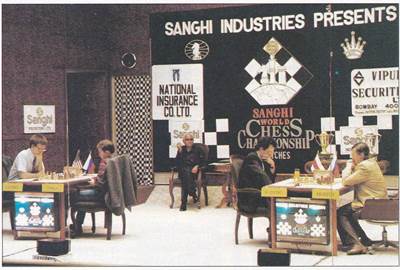
Another source is a three page report in Europe Echecs, April 1995 p.8, signed 'Leontxo Garcia (WCS)'. Just like our previous sources, the article was illustrated with photos by Bill Hook. This photo shows the playing hall.

I'll come back to both the book and the French language magazine in another post.

18 January 2023

Karpov on 1994-95 Sanghi Nagar

Two weeks ago, in 1994 Sanghi Nagar (January 2023), I developed a list of Kasparov and Karpov columns from Chess Life in the 1990s. I also gave myself an action:-
Of immediate interest are the four Karpov columns discussing the FIDE Sanghi-Nagar events. I'll look at these four columns in more depth in a future post.

I've documented the FIDE Sanghi-Nagar events on my page 1994-96 FIDE Candidates Matches (m-w.com). There I split the matches into three stages, listed below in chronological order:-

  • Quarterfinal matches - Wijk aan Zee, I, 1994. [six matches]
  • Semifinal matches - Sanghi Nagar, VII-VIII, 1994. [three matches]
  • Final matches - Sanghi Nagar, II, 1995. [two matches]

For the 'Quarterfinals', the ten top finishers from the 1993 Biel FIDE Interzonal Tournament (also m-w.com; July 1993), were joined by two players (Timman and Yusupov) eliminated in the last stages of the previous cycle, 1991-93 Candidates Matches (ditto; Final match in January 1993). The six winners were then reduced to three players in the 'Semifinals'. They were joined by Karpov in the 'Finals', after which the two victorious players met in the 1996 FIDE Title Match (ditto; June-July 1996).

That's how I understood the FIDE cycle at the time I created those pages in 1997. It turns out that my understanding was not in line with official terminology. Let's follow Karpov's explanations from his Chess Life (CL) columns.

CL 1994-12 Sanghi Nagar

The match of my future opponent [Gelfand - Kramnik] was of most interest to me personally. If we talk about forecasts, then it must be stated that many preferred the chances of the young star, Vladimir Kramnik. His victories over Kasparov were mentioned in this regard. But his opponent was also not the easiest to deal with. It is no accident that Boris Gelfand was clear first in the 1993 Interzonal, and tied for first with Ivanchuk in 1990.

Karpov also discussed the Kamsky - Anand match played at the same time. He continued the discussion in the next column.

CL 1995-01 Sanghi Nagar, Part II

White's passive play [i.e. Anand] in game seven decided the outcome, and the match became tied! The last game of regulation time ended in a draw, and the match went into overtime and was decided by Rapid Chess games! What a horribly stupid idea of FIDE -- mixing one kind of chess with another. If not for all of the twists and turns of this match, Anand would have been the clear favorite in overtime, judging by the results of Rapid Chess tournaments. But the situation in the match was already abnormal. Kamsky was on the rise, and Anand was in a depression!

Kamsky won the match, having overcome a 0-2 deficit after four games of the main eight-game match. Karpov's condemnation of the tiebreak stage -- 'mixing one kind of chess with another' -- sounds curious in 2023, where progressively faster time controls are the norm for tiebreak. The next stage of the FIDE Candidates Matches, with Karpov participating, was held six monthe later.

CL 1995-06 Sanghi Nagar: The Semi-Finals

After a successful quarterfinal, our new chess admirer, Ravi Sanghi, decided to sponsor the semifinal match in Sanghi Nagar. For the first time we played under the reformed FIDE rules, whereby the reigning world champion enters before the final match. However, we maintained the old terminology, which creates confusion. In comparison with the old system, this would have been the finals. The system needs to be further refined, but I believe this is more democratic and offers less advantage to the world champion in defending his title.

NB Karpov: 'In comparison with the old system, this would have been the finals.' Hello, confusion! Looks like I misunderstood in 1997. The *error* has been on my page for so long, that I'll just leave it as is. Karpov continued,

Nowadays, missing a stage in the cycle (and having more time to prepare for the most dangerous opponent) confers a great advantage upon the defending world champion. When the changes were proposed by the FIDE Expert Commission I didn't oppose them, but simply restated my position which I had already expressed in 1988.

There is one major inconsistency in the new system, which is when the world champion doesn't pass through the first stage. According to the rules, the world champion maintains his title until the end of the cycle, but in reality this is ridiculous. Fortunately for the new ideas and changes, this did not occur during this new FIDE World Championship cycle.

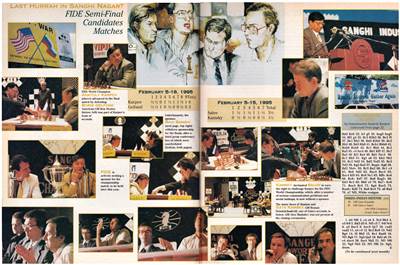
Karpov's column discussed games from the Kamsky - Salov match, won by Kamsky and thereby qualifying him into the title match. The column was 'continued' in the same issue of Chess Life, a two page report titled 'Sanghi Nagar, photo essay by Bill Hook', pictured in full below.


Chess Life, June 1995, p.46-47

The Bill Hook report was the only CL report on that stage of the FIDE Candidates Matches, where an American qualified into a World Championship title match. Karpov's column for the following month discussed his match with Gelfand, who was eliminated for the title match.

CL 1995-07 Sanghi Nagar, Part II

[Nothing special to highlight]

We've already seen a high level look at the title match by CL on my main blog in May 1970 & 1995 'On the Cover' (May 2020). Where can we find more detail about the two Sanghi Nagar events?

04 January 2023

1994 Sanghi Nagar

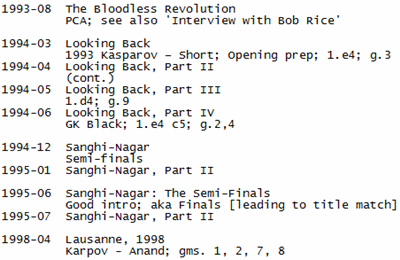
Last week, on my main blog, I developed a table overviewing Chess Life columns written by Kasparov and Karpov that covered the period when the two were World Champions for rival organizations, FIDE and PCA; see World Championship Columnists (December 2022). Many of the columns discussed World Championship events, so I summarized them in the following extract from the table.

The Kasparov columns are dated through 1994-06; the rest are Karpov columns. Of immediate interest are the four Karpov columns discussing the FIDE Sanghi-Nagar events. These are summarized on my page 1994-96 FIDE Candidates Matches (m-w.com). I'll look at these four columns in more depth in a future post.

02 November 2022

Smartchess Interviews Karpov

Yesterday's post on my main blog, November 1972 & 1997 'On the Cover' (November 2022), was partially based on the November 1997 issue of Chess Life. I ended the post saying,
An article by Rachel Landry featured an interview with then FIDE World Champion Anatoly Karpov, plus his relationship with GM Ron Henley and Smartchess Online. Is this worth a follow-up?

Indeed it is worth a follow-up. Karpov gave his side of two hot topics from the second half of 1997. The first topic involved a reunification match that was never held. For background, see FIDE/PCA Chronology (m-w.com; Feb 1993 - Oct 1996).

RL: There have been many rumors circulating about a World Championship rematch in Compiegne, France. Carol Stroe, the proposed organizer for this event, said in a press release that you and Garry Kasparov were close to signing a formal accord. Mr. Kasparov's publicity agent fervently denies these rumors. Were you approached about such a match?

AK: Yes, but no agreement was signed.

RL: What is the true likelihood of a World Championship rematch between you and Kasparov?

AK: It is possible but not in October, and as I said before, nothing is definite until an agreement is signed and a prize fund is agreed upon.

The second topic involved the introduction of the much-criticized knockout matches to determine the title of FIDE World Champion.

RL: Will you be playing in the FIDE World Championship Knockout matches?

AK: Yes. I'm playing in the final as defending champion.

RL.: A letter signed by sixteen grandmasters was delivered by Vladimir Kramnik to the 68th FIDE Congress in Moldava. This letter conveyed these players' concerns about seeding arrangements in the upcoming FIDE World Championship Knockout. Can you shed any light on what took place in Moldava with regards to this letter?

AK: I heard Kramnik would be there with the letter. Kramnik read the letter to the assembly, and gave his point of view. Later, I addressed the assembly. Subsequently there was a vote by the FIDE Congress to uphold the original arrangements under which the Championships were organized: that is if Kasparov and myself were playing, then we would both be seeded into the semifinals; whereas if one us was not participating then the other would be seeded automatically into the final. Indeed, the original papers I signed regarding my participation were based on this exact arrangement, and Kramnik amicably agreed that he would abide by FIDE's decision. Incidentally, I met the former President of the New Jersey State Chess Federation, E. Steven Doyle, in Moldava, and we discussed a number of interesting things.

All of this was happening at the same time I was building my WCC site, as I documented earlier this year in The First Quarter Century (September 2022). I researched the 'FIDE/PCA Chronology' partly because I wasn't sure who the *real* World Champion was.

The Karpov interview included many more details related to Smartchess Online, one of the earliest chess web sites. Its first capture in the 'Wayback Machine', dated January 1999, shows the following home page.


Source: http://smartchess.com/ (web.archive.org).

A footnote to the interview mentioned that it first appeared on Smartchess Online in September 1997. I tried to find the original interview via the Wayback Machine, but failed. Smartchess.com appears to have been built using techniques that are incompatible with Wayback assumptions. The period in which Smartchess was active was a controversial time for the World Championship and its association with Karpov might provide valuable background material. I'll try to look at its Wayback records another time.

In the meantime, some other subjects for 'normal' web searches related to Smartchess are GM Ron Henley, Rachel Landry, Paul Hodges, Irina Krush, R&D Publishing, and Hikaru Nakamura. The home page pictured above leads to the 'November - December 1998' issue of Smartchess Online, with the following headlines:-

  • '1998 US Championships: SmartChess Online coverage with GM Ron Henley & NM Irina Krush. • Congratulations! SmartChess Online Columnist Irina Krush, 1998 US Women's Chess Champion!'
  • 'Press Release: "Krush Challenge" Series. Irina Krush to play a match against GM Walter Browne'
  • 'Press Release: SmartChess Online welcomes its new Columnist - NM Hikaru Nakamura'

Krush was 14 years old at the time. Nakamura was 10.

In his interview with Smartchess, Karpov mentioned a couple of video series he was developing for Smartchess's 'WWW Chess Superstore'. I've featured two of these in posts on my main blog:-

How many more of these videos are still available on Youtube? That makes a second topic for follow-up.

17 February 2021

Olimpbase Zonals

In last week's post, Another Azmai Controversy? (February 2021), I discovered an exciting development on Olimpbase concerning the documentation of zonal tournaments. As a consequence, I assigned myself a future action:-
For further investigation: [...] How much more than 'Zonal 1.2b, Struga 1995' is available on Olimpbase?

Unable to find an index to zonals on the site, I concentrated on the directory where the zonal files are located: olimpbase.org/ind-wcc. I loaded the filenames of the zonal pages into a database and learned that they were all similarly structured:-

[cycle]-zonal[info], e.g. 'wc1998-zonal12b' for the Struga 1995 page mentioned above.

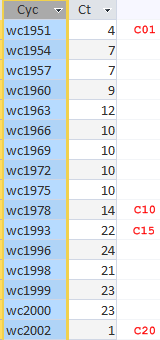
This let me count the number of zonals available for each [cycle], as shown in the following chart (excludes playoffs).

For example, the 'wc1998' cycle has 21 zonals associated with it, of which one is the Struga 1995 page. The codes shown in red in the last column correspond to my system of numbering the cycles. From this we can see that cycles C01 through C10 are represented, C11 to C14 are missing, and C15 to C20 are represented, although C20 has only a single zonal. (The current cycle is C29.)

The largest number of zonals are from the 'wc1996' cycle (C16), so I decided to compare the Olimpbase data with my own data on the page C16: 1993-1996 Zonal Cycle. The word 'compare' isn't the most precise term, because Olimpbase has full crosstables, round-by-round progress, and much more, where I often have only the year/place of the event with a clipping to confirm its existence elsewhere in chess literature. For example, my C16 page mentions,

1.5a Kladovo YUG 1993-06
1.5a Zouberi 1993-00

On several occasions I've looked for more info about these events, without success. The equivalent Olimpbase page, Zonal 1.5a, Kladovo/Zouberi 1993, has crosstables for both events plus links to a corresponding PGN file and a playoff. The Olimpbase home page, OlimpBase :: the encyclopaedia of team chess (olimpbase.org), currently says, 'Individual tournament finally available - a long expected feature is ON', plus:-

Under construction a.o.: • Individual World Championship (including complete results of zonals) • Individual Continental Championship (Panamerican, Asian, African, European) - most complete! [...]

This indicates that the championships of the four continents, which are equivalent to zonals for cycle qualification, are available elsewhere. The site's right sidebar lists all four under 'Continental Championships', but the links only lead back to the Olimpbase home page. Technical glitches of this sort are common on new resources. The timestamps on the zonal pages show that most were released on May 2020, so I expect we'll see updates at some time in the future.

OlimpBase's Wojciech Bartelski shows once again that he is a trailblazer in chess history. Thanks, Wojciech!

***

Later: Re...

The site's right sidebar lists all four under 'Continental Championships', but the links only lead back to the Olimpbase home page. Technical glitches of this sort are common on new resources.

...the 'glitch' was mine. I was trying to open the links in a new browser tab -- as I often do -- but the target page was not loading as it usually does. It was defaulting to the site's home page. A straightforward click on the link produces the desired target page. Apologies for the misleading remark!

30 October 2019

2019 Grand Swiss Results

I added the crosstable to my page on the 2019 Grand Swiss; Isle of Man. Still to be done are adding the PGN and updating the Index of Players. In the previous post, 2019 World Cup Regulations, I wrote,

I started the process of adding a crosstable to my page for the 2019 Grand Swiss, which finished this week. While preparing the PGN, I counted 154 players and 841 games. [...] One question I haven't answered is how to update the index of players. I imagine that many players who participated in the Grand Swiss will never play in another World Championship event. Is it worthwhile adding their names to the index? I'll have to count the number of new players before I decide how to proceed.

A preliminary count gave 38 new players, or about 25% of the 154 players who participated. This compares to the 30% (38/128) that I counted a few weeks ago in 2019 World Cup Players. That statistic gives me a green light to add all of the new players to the index. • NB: The qualification paths for the participants are documented in FIDE Chess.com Grand Swiss Preview (chess.com; Peter Doggers).

It's also worth mentioning two previous tournaments that were part of the FIDE World Championship cycle and that used the Swiss system format:-

These were the last Interzonals organized before the knockout format replaced the entire tail-end of the cycle.

29 May 2019

Zonal Qualifiers C13-C16

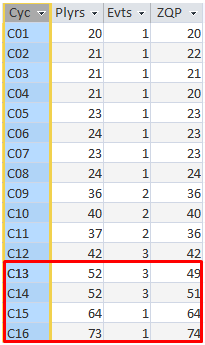
In the previous post, Zonal Qualifiers C01-C16, I started working with a summary of the qualifying paths from the zonal stage to the interzonal stage for the earliest World Championship cycles. On top of zonals, these paths included other means of seeding players into the Interzonals, like rating. To facilitate comparison, I created a table which is also shown near the end of today's post.
The table shows my count of the number of players who participated in the interzonals for C01 through C16. [...] The last column shows the number of players documented in the zonal material that I'm using as the base for this exercise. The table gives me a guide for further work on this particular project. [...] The new data lets me complete C01-C12 and also lets me doublecheck C13-C16.

The cycles C13-C16 took place during FIDE's darkest days. Let's have a recap of the interzonals that spanned nearly a decade.

C13 unfolded during the uncertainty of the first three Kasparov - Karpov (K-K) matches, when the continuity of the previous cycle (C12) had been disrupted and had entered uncharted territory. For C13, FIDE scrambled to organize something resembling a traditional cycle. There were three Interzonals that eventually led the way to the fourth K-K match.

C14 was played in (more-or-less) traditional circumstances. It was the last cycle to have three Interzonals. They culminated in the fifth K-K match, the last match between the two 'K's.

C15 saw the introduction of a single interzonal tournament using a Swiss system format instead of the traditional round-robin format. The cycle would eventually lead to the schism between FIDE and Kasparov, with two parallel World Championship matches.

C16 was played as the schism was deepening, with two parallel World Championship cycles. No one knew where world class chess was going.

The following chart is taken from the previous post, 'Zonal Qualifiers C01-C16', and highlights the four cycles featured in today's post. The counts show the approximate number of players who qualified into the interzonals for those cycles.

I compared the lists of players from my record of interzonals and the summary of zonal qualifying paths (ZQP). After identifying differences in the spelling of players' last names (needs more work to establish the accepted spelling) and accounting for the order of Asian names (like 'Qi Jinguan' and 'Jinguan Qi' in C13) I worked out the reason for the different numbers.

In C13 and C14, a total of four players were missing from the ZQP lists. C15 matched perfectly. C16 was due to a mismatch between my page on 1993 Biel and my Index of Players (they should also match); the ZQP data was perfect.

All things considered, I was pleased with the correlation between my data and the ZQP data. It was even better than I had hoped for and confirmed my belief that the ZQP data is an excellent source of info on the early FIDE zonals and interzonals.

08 July 2015

Zonal Qualifiers C16 - Qualification Paths

I ended my previous post, Regulations for Qualifiers C16, saying, 'There are still some blanks to be filled, so I'll continue this exercise for my next post.' I returned to the two pages

filled in the blanks, double-checked some assumptions, corrected a few errors, and added the list 'Player - How qualified' to the 'Zonal Qualifiers' page.

The table on the left is similar to the one shown in Zonal Qualifiers C17 - Qualification Paths. It counts and summarizes the qualification paths of the 74 players who competed in the 1993 Biel FIDE Interzonal.

The letters in the left column correspond to the paragraphs from the first section of the 'Zonal Qualifiers' page ('Comment ils se sont qualifiés' = 'How they qualified'). For example, 'a' counts the players who qualified on rating, 'e' counts players who qualified as ex-World Champions (only Smyslov accepted), and 'z' counts players who qualified via a zonal.

The counts total to 76, so where do the two extra players come from? Europe Echecs listed ten players qualified on rating ('a'), but only eight eventually played (Azmaiparashvili and Christiansen were missing). On top of that, I identified another six players who didn't qualify by any obvious path. Since they all had ratings in the same range, I assumed they also qualified on rating and assigned them code 'a?' to keep them separate.

For my next post, I'll tackle qualification paths for the preceding cycle, Zonals 1990-1993 (C15).

01 July 2015

Regulations for Qualifiers C16

After Zonal Qualifiers C17 - Qualification Paths, and continuing to work backwards in time, I tackled the preceding cycle, C16. First I located a list of players who qualified for the interzonal and added the clippings to Zonals 1993-1996 (C16). The same source, Europe Echecs, had an overview of the regulations in force at the time. I used this to start a new page Zonal Qualifiers 1993-1996 (C16).

Combining this information with the players who finally participated in the 1993 Biel FIDE Interzonal Tournament, let me work out how most of the players qualified. There are still some blanks to be filled, so I'll continue this exercise for my next post.

24 June 2015

Zonal Qualifiers C17 - Qualification Paths

Continuing with the 1997 World Championship, FIDE Knockout Matches (Groningen), I ended my previous post, Regulations for Qualifiers C17, with
The regulations plus the list of qualified players plus the clippings from 'Zonals 1995-1997', allowed me to work out how most/all(?) of the players qualified for the knockout tournament. For my next post, I'll check this work once more before adding it to the new page on 'Zonal Qualifiers 1995-1997'

Good thing I rechecked, because I found a number of unclear or inaccurate points. First I added a new clipping -- Europe Echecs 1997-11 -- to the 'KO Qualifiers' section of

Then I added a list of the qualified players -- 105 by exact count -- to

The same page ends with a list of qualified players who did not compete, e.g. Kasparov and Kramnik.

The table on the left counts and summarizes the qualification paths of the 105 players. The letters in the left column correspond to the bullets from paragraph 12.12 of that 'Zonal Qualifiers 1995-1997' page ('Regulations for the 1997/8 World Championship'). For example, 'a' counts Karpov and Kasparov, who both received special treatment; 'e' counts the players who qualified from a zonal.

The rest of the counts match the regulations nicely except for 'j' ('Nominees of the Organizing Federation') which should be two nominees. The count for 'k' ('sufficient number of the highest rated players') includes all names that couldn't be placed elsewhere, which was guesswork on my part.

One other point deserves mention. Section 12.13 of the regulations states,

d) Where Kamsky fails to enter, his place in Round 3 [of the 1997 Groningen KO] shall be taken by the loser from Round 3 of the previous Candidates match.

Kamsky did not enter and his place was taken by Gelfand. According to my page on the 1994-96 FIDE Candidates Matches, in the last round Gelfand lost to Karpov, and Salov lost to Kamsky, thereby setting up the Karpov - Kamsky title match. It's not clear to me why Gelfand was favored over Salov for rule 12.13(d).

With that little mystery in the back of my mind, I'll move on to qualifiers for C16: 1993-96.

07 January 2015

Books on the Carlsen - Anand Matches

Anyone interested in a book on one or both of the Carlsen - Anand title matches? I imagine many people are, so let's take a look at what's available. Amazon.com currently lists five titles. I've grouped them here by author, with links to the corresponding Amazon pages.

Karsten Müller

Jon Edwards

Raymond Keene and Anastasiya Karlovich

Bookfinder.com lists only the Keene / Karlovich titles: Title is anand carlsen; Book is written in English. Why is that? The Müller and Edwards titles are listed on Amazon as 'Kindle Edition', implying that they are only available in digital format.

The two Keene / Karlovich works are both listed on Amazon as 'Publisher: Ishi Press'. I am extremely reluctant to buy anything published by that outfit, not just because the book on the 2013 match has two stars (out of five) based on three customer reviews, while the book on the 2014 match has one-and-a half stars on two reviews.

I already have one book by Ishi Press: ELISTA DIARIES: Karpov-Kamsky, Karpov-Anand, Anand Mexico City 2007 World Chess Championship Matches by Anatoly Karpov and Ron Henley; December 5, 2007. The Karpov / Henley writings, which make up the bulk of the book, are first rate, but the rest is not.

For example, the last page of the book discusses the following photo. The discussion is signed 'Sam Sloan'.


'Hot Tomalis [sic] on the Mexican Professional Chess Player circuit?'

'Nondescript women'? Before reading Sloan's petty, sexist writeup, many players would recognize Arianne Caoili and Aruna Anand. They might also wonder what they have to do with the Karpov / Henley material. In a word, they have *nothing* to do with it.

Back to the Keene / Karlovich works, the name Raymond Keene also raises a red flag. I have a number of his books on title matches, which I listed in World Championship Bibliography. While I wouldn't mind buying another work in his series, other knowledgeable chess fans wouldn't go near them.

The names Ishi and Keene taken together convince me to keep my money in my wallet. Buyer beware.

31 July 2013

Averbakh on the World Championship

In yesterday's post on my main blog, Friendly Chess Players, I introduced Averbakh's 'Centre-Stage and Behind the Scenes: A Personal Memoir'. The book is filled with stories about the World Championship, some of them new to me, many of them in more detail than I've seen before. Here's a list, each entry starting with its first page number in the book.

059 : 1950 CT
063 : 1951 19th USSR Chp semifinal (pre-zonal)
064 : ---- Pen portraits (A)
070 : 1951 19th USSR Chp (zonal)
071 : 1952 IZ
078 : 1953 CT
092 : 1955 22nd USSR Chp (zonal)
100 : ---- Sparring partner to MB
108 : 1958 25th USSR Chp (zonal)
110 : 1958 IZ
112 : ---- Early rules for WCC
120 : 1959 CT
129 : 1962 CT
147 : 1968 IZ playoff
154 : 1971 CM: TP-VK, RF-TP
157 : ---- Baturinsky
163 : 1972 WC: RF-BS
164 : 1963 VS & zonal
166 : 1974 CM: TP-LP, VK-TP
169 : 1977 CM: VK-TP
171 : 1974 FIDE Congress: AK-RF
175 : 1974 CM: AK-VK
178 : 1976 VK defection
185 : 1978 WC: AK-VK, Sevastianov
190 : 1982 IZ
193 : 1972 WC: RF-BS, Euwe
194 : 1982 FIDE President Campomanes
199 : 1982 CM: VS-RH, VS-ZR, GK-VK
214 : 1984 WC: AK-GK I
220 : 1985 WC: GK-AK II
221 : 1986 WC: GK-AK III
223 : 1987 FIDE Presidential election, GMA
223 : 1987 WC: GK-AK IV
224 : 1988 USSR Chp, GK-AK playoff
227 : 1988 USSR vs. World charity match
229 : 1990 Women's CT, Krogius
232 : 1972 Graz, Huebner - Rogoff (B)
233 : 1990 FIDE Presidential election
235 : 1987 GMA
236 : ---- Chess psychology (C)
240 : 1982 OL: Manila
242 : 1993 Schism, PCA, GK-NS, AK-JT
247 : 1994 OL: Salonika -> Moscow
250 : 1994 FIDE Presidential election
251 : 1995 FIDE Congress, Paris, Ilyumzhinov

IZ: Interzonal
CT: Candidate Tournament
CM: Candidate Match
WC: World Championship
OL: Olympiad (esp. Congress++)

AK: Karpov, BS: Spassky, GK: Kasparov, JT: Timman, LP: Portisch, MB: Botvinnik, NS: Short, RF: Fischer, RH: Huebner, TP: Petrosian, VK: Korchnoi, VS: Smyslov, ZR: Ribli

(A) Zubarev, Blumenfeld, Duz-Khotimirsky, Rabinovich, Verlinsky, Romanovsky
(B) A little known story about the future IMF Chief Economist; nothing to do with WC
(C) Incl. six categories of player as in 'Friendly Chess Players'

Although Averbakh's book deserves a review on my blog, this summary will have to do for now.

19 August 2009

More on the Zonal Cycle 1993-1996

Continuing with my post on the Zonal Cycle 1993-1996, I added more clippings to my page on the cycle: Zonals 1993-96. Most of these were again from Europe Echecs, although the crosstable for the 1992 U.S. Championship at Durango came from Chess Life.

05 August 2009

Zonal Cycle 1993-1996

I added a page for the cycle Zonals 1993-96 to my page on The World Chess Championship : Zonals. These were events that qualified players into the 1993 Biel FIDE Interzonal Tournament.

All of the initial clippings on the new page are from the June 1993 issue of Europe Echecs, which had a two page summary of zonals compiled by Christophe Guéneau. The summary also had an explanation of how certain players qualified through means other than zonals, an overview of which top players were missing and why they had not qualified, and a list of all qualifying players. For a mainstream chess magazine, the EE article was an unusually thorough compilation of zonal activity.