Showing posts with label C13: 1985-87. Show all posts

30 November 2022

Karpov the 12th

I'm bouncing between two blogs here. A month ago on this blog I posted, Smartchess Interviews Karpov (November 2022). There I noted,
The period in which Smartchess was active [late 1990s to mid-2000s] was a controversial time for the World Championship and its association with Karpov might provide valuable background material. I'll try to look at its Wayback records another time.

That led to a follow-up on my main blog, Wayback to Smartchess (November 2022):-

In his interview with Smartchess, Karpov mentioned a couple of video series he was developing for Smartchess's 'WWW Chess Superstore'. I've featured two of these in posts on my main blog [see links; ...] How many more of these videos are still available on Youtube?

The answer to that last question is 'More than I expected', all on Youtube channel iChess.net. Here's one.


Karpov on Kasparov - 1984 World Chess Championship (18:17) • '[Published on] Jun 30, 2012'

The description said,

Who better to analyse Garry Kasparov's World Championship games than his opponent and eternal rival, Anatoly Karpov? Get instant access to Karpov's astounding analysis of his matches against Kasparov. [...]

Right-click the embedded video to find the original page and see the rest of the description. It points to a page titled Karpov on Kasparov - His World Chess Championships (1984-1990) (ichess.net). The description there said,

Overview: Karpov On Kasparov – His World Chess Championships (1984-1990) • 3-disc set converted, reauthored, and remastered by OnlineChessLessons.net. Total Run-time: 275 minutes. • Volume I - 1984/1985 [KK-1]; Volume II - 1987; Volume III - 1990

So the 1985 and 1986 matches [KK-2 & -3] are missing? I imagine the memories for Karpov were too painful after he surrendered his World Champion title in both.

There are more video series by Karpov available from Youtube and iChess.net. It's also worth noting a post from last year, Carlsen's TMER 2019-21, Chess24 (November 2021), where I wrote,

Current information about [the company 'Play Magnus'] is available from its web site. The following image from the site's main page lists eight subsidiaries: [...] and iChess.net.

Will I find the occasion to overview the other Karpov videos? Maybe, but I might have to bounce back to my main blog to do that.

29 May 2019

Zonal Qualifiers C13-C16

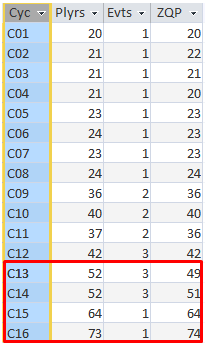
In the previous post, Zonal Qualifiers C01-C16, I started working with a summary of the qualifying paths from the zonal stage to the interzonal stage for the earliest World Championship cycles. On top of zonals, these paths included other means of seeding players into the Interzonals, like rating. To facilitate comparison, I created a table which is also shown near the end of today's post.
The table shows my count of the number of players who participated in the interzonals for C01 through C16. [...] The last column shows the number of players documented in the zonal material that I'm using as the base for this exercise. The table gives me a guide for further work on this particular project. [...] The new data lets me complete C01-C12 and also lets me doublecheck C13-C16.

The cycles C13-C16 took place during FIDE's darkest days. Let's have a recap of the interzonals that spanned nearly a decade.

C13 unfolded during the uncertainty of the first three Kasparov - Karpov (K-K) matches, when the continuity of the previous cycle (C12) had been disrupted and had entered uncharted territory. For C13, FIDE scrambled to organize something resembling a traditional cycle. There were three Interzonals that eventually led the way to the fourth K-K match.

C14 was played in (more-or-less) traditional circumstances. It was the last cycle to have three Interzonals. They culminated in the fifth K-K match, the last match between the two 'K's.

C15 saw the introduction of a single interzonal tournament using a Swiss system format instead of the traditional round-robin format. The cycle would eventually lead to the schism between FIDE and Kasparov, with two parallel World Championship matches.

C16 was played as the schism was deepening, with two parallel World Championship cycles. No one knew where world class chess was going.

The following chart is taken from the previous post, 'Zonal Qualifiers C01-C16', and highlights the four cycles featured in today's post. The counts show the approximate number of players who qualified into the interzonals for those cycles.

I compared the lists of players from my record of interzonals and the summary of zonal qualifying paths (ZQP). After identifying differences in the spelling of players' last names (needs more work to establish the accepted spelling) and accounting for the order of Asian names (like 'Qi Jinguan' and 'Jinguan Qi' in C13) I worked out the reason for the different numbers.

In C13 and C14, a total of four players were missing from the ZQP lists. C15 matched perfectly. C16 was due to a mismatch between my page on 1993 Biel and my Index of Players (they should also match); the ZQP data was perfect.

All things considered, I was pleased with the correlation between my data and the ZQP data. It was even better than I had hoped for and confirmed my belief that the ZQP data is an excellent source of info on the early FIDE zonals and interzonals.

07 November 2018

2018 Carlsen - Caruana, Warmup

With the 2018 Carlsen - Caruana title match due to start in two days, the entire chess world turns its attention to London. First, here's a summary of pre-match posts on this blog:-

Add to these a couple of posts from my main blog:-

I expected more in pre-match publicity from FIDE / Agon / Worldchess. I should know better than to expect more, but we can always dream. The most comprehensive writeup to date appeared a couple of days ago from another source -- The Couch Potato’s Guide to the 2018 World Chess Championship (uschess.org) by GM Ian Rogers -- and even mentioned my own resources:-

Mark Weeks’ long-running World Championship site and blog cover both history and less well known World Championship news.

How long-running has the coverage been on this blog? Here's a summary of wrapup posts for past title events:-

I haven't noticed much Carlsen - Caruana reporting from the non-chess press and hope I get some material for the next post in the Yahoo series. The most interesting report so far is Marky’s Malarkey: Betting On the World Chess Championship (actionnetwork.com; 'Marky takes a deep look into the world of chess to find out where the value lies.'). I'm not a gambler and Marky’s Malarkey is full of jargon that leaves me baffled: 'prop bet', 'shop for the best line', 'both a Pinnacle and Bovada account', etc. etc.

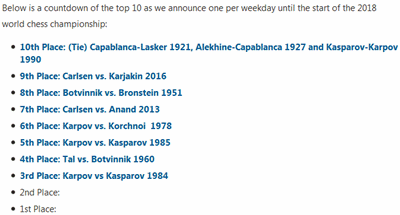
More in my comfort zone is a countdown series by Chess.com's Mike Klein: The 10 Most Exciting World Chess Championships Ever (started end-October 2018). Here's his list to date.

No.1 on the list is a no-brainer, 1972 Fischer - Spassky, but what about no.2? I'll put my money on 1987 Kasparov - Karpov. The match was tied going into the next-but-last game, the 23nd, which Karpov won thanks to a blunder by his opponent. Needing a win to keep his title, Kasparov presented a classic example of how to handle a clutch game. As I wrote on my highlights page for the match, 1987 Kasparov - Karpov : Highlights,

A few moves into the resumption, Karpov played an inaccurate move and resigned on his 64th move. Thus are the greatest world chess championship matches decided -- two months of mental combat turn on a single move. Since the match ended in a 12-12 draw, Kasparov retained the title for another three years.

In 2018, tied title matches are decided by rapid and blitz tiebreak games. That raises the excitement by several more notches.

16 May 2018

A Two Year Cycle

For the last few World Championship cycles, FIDE has managed to maintain a two year rhythm, with title matches taking place at the end of even-numbered years (like 2018). How many chess fans remember that FIDE tried to do the same nearly 35 years ago? From Informant 36 (1983-H2):-
A new system of competitions for Individual and Team World Championships was adopted by FIDE at its congress in Manila, in October 1983. The proposal was being prepared for some time by an ad hoc Committee headed by Mr. Campomanes, the President of FIDE.

The new system contains many changes:

• a restructuring of FIDE Zones was carried out (new distribution of countries among the Zones, two Zones in Africa, the so-called Sub-zones set up in some Zones);

• a two-year cycle of competitions for Individual World Championship was introduced to replace the hitherto three-year cycle (i.e., the World Title Match will henceforth be played every other year);

• 12 (in 1985, 14) best players from the FIDE rating list will also have the right to participate in three Interzonal Tournaments;

• a candidates' all-play-all tournament with 16 participants was instituted, to be played after the Interzonal Tournaments;

• Individual Candidates' Matches with four participants -- the players placed lst-4th in the Candidates' Tournament -- will be played after the candidates' all-play-all tournament;

• in addition to the Chess Olympiad, a World Team Championship (with ten participant teams) was instituted to be played every fourth year.

What happened to this grand plan? The infamous 1984 Karpov - Kasparov title match (Moscow; 1984-09 through 1985-02) took place.

21 March 2018

Berlin Candidates - Second Week

In last week's report on the 2018 Berlin Candidates Tournament (see Berlin Candidates - First Week), we saw three players with a plus score after three rounds:-
2.5 Kramnik; 2.0 Caruana, Mamedyarov

Another six rounds have been played, again leaving three players with plus scores:-

6.0 Caruana; 5.5 Mamedyarov; 5.0 Grischuk

In past reports on Candidates tournaments from previous cycles, like Moscow Candidates - Second Week (March 2016), I presented a crosstable from the offical site. I could find no such chart on the official site for the current tournament, so I took a snapshot of the crosstable from the news site that most of the English-speaking chess world uses for up-to-date chess information.

FIDE Candidates Tournament 2018

Source: The Week in Chess

The chart shows who will be playing whom in the last five rounds. The schedule for the critical games between the current leaders is:-

Round 10: Mamedyarov - Caruana
Round 13: Mamedyarov - Grischuk
Round 14: Grischuk - Caruana

In my 'First Week' report, I developed a chart from the last three Candidates tournaments projecting winners at different points in the events. The same observations were offered by GM Ian Rogers in his report on the first half of the Berlin event, Caruana Leading Candidates Race: “I’ll Try to Stay Calm.” (uschess.org; 18 March 2018):-

In the modern era, the winning recipe for qualifying to challenge the World Champion from the Candidates Tournament has been to be in the lead at the halfway mark. In fact one has to go back to 1959 to find a Candidates Tournament where the winner was not leading halfway through the event. [...] The winners in 2013, 2014 and 2016 – Carlsen, Anand and then Karjakin – were always tied with Levon Aronian at the halfway point, before going on to outpace the Armenian.

I double-checked GM Rogers on his facts from the earlier cycles and discovered that in the eight player, four stage round-robin 1959 Yugoslavia Candidates, the unlucky Paul Keres was leading at the half-way point with 10.0/14, a half point ahead of Mikhail Tal, who eventually won the event. In the 1962 Curacao Candidates, which used the same structure as in 1959, GMs Petrosian and Geller were leading at the half-way mark with 9.0/14. Petrosian eventually finished a half-point ahead of Geller and Keres. That tournament was marred by accusations that the three leaders colluded to draw against each other (which the crosstable confirms) and to play for wins against the other participants, the non-Soviets in particular.

For those suspicions of collusion, the Candidates stage of subsequent World Championship cycles was changed to a system of long matches which -- except for a handful of cycles using a single-event knockout system -- persisted until a round-robin tournament was reintroduced for the 2013 London Candidates. For more about Soviet collusion in Candidates tournament of the 1950s, see Calculating Collusion (February 2010) on this blog.

Predictions based on the leader at the halfway mark also held for two title tournaments in the 2000s. At 2005 San Luis, GM Topalov was ahead of the next player, GM Svidler, by two full points after seven rounds. At 2007 Mexico City, GM Anand was ahead of GM Gelfand by a half point after seven rounds.

The only Candidates tournament for which I haven't developed a cumulative score by round is the 1985 Montpellier Candidates. That event was unusual in that it qualified the first four players into a short series of matches.

28 June 2017

Spassky: 'The Dr. Zhivago of Chess'

In a recent post on my main blog, Sports Illustrated 'On the Cover', I showed that a prominent American sports magazine ('SI') once demonstrated a keen interest in chess. Through the series of Kasparov - Karpov clashes in the 1980s, SI had regular, multi-page features on top World Championship events. Here, for example, are the first two pages of a five-page spread on the Korchnoi - Spassky final in the 1976-78 Candidates Matches.


Sports Illustrated, 12 December 1977

The article started,

With the notable exception of Bobby Fischer, who won the world championship from Boris Spassky in 1972 in a memorable Icelandic psychodrama, Soviets have dominated world chess for 30 years. And their reign is not about to end. This week, in the shabby elegance of the Dom Sindikata Theater in Belgrade, Yugoslavia, two Russians, Spassky and Viktor Korchnoi, are meeting for the right to play still another Russian, 26-year-old world champion Anatoly Karpov, for the title.

Spassky is now 40, and his figure, which was trim in Reykjavik, is a bit fleshier, his dark hair longer and more styled. But the same calm green eyes study the board, and the same long artistic fingers are placed along his cheekbones. The world champion from 1969 to 1972, Spassky remains the gentlemanly, dignified, poetic grand master, the Dr. Zhivago of chess.

Across the board sits the volatile, daring Korchnoi, 46, the world's No. 2 grand master. In further contrast to Spassky, the formerly chubby Korchnoi has lost a great deal of weight recently. His brown eyes glitter, his shoulders hunch as he lunges forward to advance a bishop into dangerous territory. Korchnoi seeks the dangerous position -- in life as well as at the chessboard.

That's the sort of colorful sports reporting that is seldom seen outside of the mainstream press. Here is a list of all SI articles on the World Championship that I was able to locate.

  • 1960-04-18: A New Moscow Revolution • 'Mikhail Tal's brilliant and bewildering victories in world championship chess stunned the Russians'
  • 1960-05-30: A Nod for a Title • 'Sports Illustrated's correspondent in Moscow reports on the new world chess champion Mikhail Tal and on the new chess era that opened with a smile'
  • 1961-05-08: The Young Botvinnik • 'An aging champion created a new training technique to recover the fire of youth -- and his title'
  • 1967-11-20: The Further Adventures of Terrible-tempered Bobby • 'Bobby Fischer played like a champion at the international tournament in Tunisia, but he ended by forfeiting his way out of the competition'
  • 1971-08-02: Maybe You Can Win Them All • 'Bobby Fischer has pitched 19 no-hitters in a row'
  • 1971-11-08: Bobby Clears the Board for the Title • 'The young U.S. master, after Tigran Petrosian smashed his 20-game streak, closed strong to earn a shot at the world's chess champion'
  • 1972-07-10 A Sudden Stalemate in Reykjavik • 'The world championship was plunged into check when Bobby Fischer decided that a better game was hide-and-seek'
  • 1972-07-24: Boris in Wonderland • 'Russia's Spassky played Alice to Bobby Fischer's Mad Hatter in Reykjavik last week'
  • 1972-08-14: How to Cook a Russian Goose • 'First, catch a Russian -- and at long last Bobby Fischer apparently has, dominating Boris Spassky so completely...'
  • 1974-01-28: Memo from Moscow: don't get byrned • 'Hot on his world chess championship comeback, Boris Spassky faces a scholarly and unintimidated American'
  • 1974-09-30: A Case of Beauty Before Age • 'Two Russians are meeting to see who will take on Bobby Fischer...'
  • 1977-12-12: Taut Duel for Two Old Comrades • 'They grew up together in Russia and meet again for the right to face the champion, but one is a defector, the other an émigré'
  • 1978-01-30: They Couldn't Zap the Viktor • 'Korchnoi came out of his match with Spassky smiling and ready for world champion Karpov, but in Belgrade he was grimly convinced that the Soviet KGB was bombarding him with rays'
  • 1978-07-31: Back to Drawing Old Board • 'The Soviet champ and a vocal defector drew the first three games of what could be a drawn-out world championship'
  • 1985-02-25: A Dubious Gambit In Moscow • 'Just when chess champion Anatoly Karpov seemed to be weakening, the challenger was abruptly checkmated'
  • 1986-11-13: Beating Back A Game Challenge • 'Anatoly Karpov played valiantly in their Leningrad showdown, but Gary Kasparov outlasted his rival to retain the world chess championship'
  • 1987-12-07: Duel Of Two Minds • 'Opposites Gary Kasparov and Anatoly Karpov battle for the world chess title'
  • 2016-11-12: Chess Pieces of History • 'Board in 1972 battle up for auction'

The reports aren't always perfect. There is sometimes confusion between the concepts of 'game' and 'match' that is irksome to many chess fans, and the 1971 baseball analogy...

Maybe You Can Win Them All • 'Bobby Fischer has pitched 19 no-hitters in a row'

...is clearly an exaggeration. Even with those nitpicks, I'll gladly accept a slightly flawed report that promotes chess to a non-chess readership. For some reason, the World Championship reports stopped after the 1980s. Was it because of a changing perception of chess as a sport, because of the political turmoil in the chess world, or because of something else? I would really like to know.

14 September 2016

The Best Psychological Chance

Garry Kasparov as chess commentator is always as interesting and as entertaining as he was during his heyday as a chess player. Here he is with Jennifer Shahade and Yasser Seirawan during the last round of the recent Sinquefield Cup.


Garry Kasparov, Commentator - 2016 Sinquefield Cup - Grand Chess Tour Round 9 (52:59) • 'Source : Chess Club and Scholastic Center of Saint Louis - YouTube'

At one point [around 30:20 into the video clip] GM Seirawan asks about Kasparov's fourth World Championship match against Karpov.

YS: Thought process: One of the hardest things in chess is to win on demand. For me, one of your greatest achievements was Seville [1987] game 24. You're trailing in the match 12-11. You have one and one result only : you have to win with White. [GK: And I was playing Karpov!] And you accomplished it. How do you play for a win on demand? In your game with Karpov, you wanted to play a long, slow game and just let his nerves... • GK: Yes, I thought it would be a game of nerves and I thought the best psychological chance...

Kasparov goes on to explain.

GK: In a last round game, the last game of the match -- a long, marathon match, ten weeks -- you don't play a game of beauty. It's all about creating psychological discomfort for your opponent. I thought that if we had a slow game, Karpov would be under pressure to simplify the position, even by making little concessions, concession after concession, because he wanted to finish the game, he wanted to reach a position where he would be out of danger. But by trying to force it, without contemplating the potential consequences, he could give me some chances. And it worked out nicely. He was gradually making his position worse and worse, he gave me a big chance and blundered in time trouble. We entered the adjournment with me having an extra Pawn and Karpov couldn't survive under the pressure.

For more about the match, see 1987 Kasparov - Karpov Title Match; Seville, X-XII, 1987. Kasparov could have been describing a typical Magnus Carlsen game.

16 December 2015

Zonal Qualifiers C13 - Qualification Paths

After locating the Regulations for Qualifiers C13, I added the qualification path for each player to the page C13: Zonal Qualifiers 1984-1987. The two tables below show the counts of players who qualified by the different paths.

The left table ('Qual') counts the types of qualifiers as defined in the first part of C13: Zonal Qualifiers. The right table ('Zonal') counts the players who qualified at a certain zonal ('z'), as listed in the second part of the same page.

The three players with an unknown qualification path (Qual = '?') -- Afifi, Bouaziz, & Hmadi -- all played in the 1985 Tunis Interzonal. Two of them qualified via African zonals and one was nominated by the Tunis organizers. I haven't been able to determine who qualified by what path.

The count for zone 4, the USSR, shows five players. GM M.Gurevich did not play an Interzonal although he qualified ahead of two other players. I haven't been able to determine why.

***

Later: To document a few discoveries, I added new clippings to C13: Zonals 1984-1987.

09 December 2015

Regulations for Qualifiers C13

Continuing with Zonal Qualifiers C15-C26 : Summary, I added a new page C13: Zonal Qualifiers 1984-1987. The first cut covers only the rules for qualification into the Interzonals, so I still need to add the qualification paths for individual players.

What happened to C14: 1987-90? I haven't been able to locate a description of the qualification rules for that cycle. I suspect that the rules for C14 were similar to C13 and will test that hypothesis after completing C13.

25 November 2015

1985 San Juan (Puerto Rico)

After sorting out the record of Central American (CAM) Zonals, there was still an open question about CAM Subzonals. On the one hand I knew that the 1985 CAM zonal was held in Caracas. On the other hand I had a curious reference in 'Hooked on Chess' by Bill Hook (p.134):-
The Puerto Ricans hosted the Caribbean zonal tournament in 1985, in San Juan. [...] The zonal was well organized by Narciso Rabell Mendez, as were all other tournaments of his that I attended. This was my third zonal, and I finished in the lower half of the field, as usual. The Cubans had the preponderance of chess strength in the Caribbean, and they took the first three places.

The best way to reconcile the contradictory pieces of information was to verify that 1985 San Juan was a subzonal, but how? A library visit wasn't possible and I could find nothing on the web except for a single game reference, William Hook vs Craig van Tilbury; Zonal Tournament (1985) on Chessgames.com (CG).

What about Hook's reference to the Cubans? From my page (C13) 1984-1987 Zonal Cycle, I knew that the Cuban players in the 1985 Caracas zonal were Amador Rodriguez and Jesus Nogueiras, but their player pages on CG didn't mention it. [I did discover, however, that GM Rodriguez was listed on CG as 'Cespedes, Amador Rodriguez' rather than 'Rodriguez Cespedes, Amador', making his record harder to find.]

CG helped by providing a link to GM Rodriguez' personal site, amadorgm.com. I took the liberty of contacting him there to ask if he had any information about the San Juan tournament. Some time later the GM answered,

I did play in San Juan in 1985, a great year, happy times. It was a sub-zonal tournament, there were two spots valid for the zonal tournament that was played next month in Caracas, where I took first and went all the way to play the Interzonal.

In Puerto Rico I shared first with GMs Nogueiras and Guillermo Garcia, all of us from Cuba. At the end we had to play a double round match to eliminate one, but Guillermo Garcia had to return home and declined to play those tiebreaks.

That info matched Hook's perfectly, so I thanked GM Rodriguez and wrote this post.

28 May 2014

KK1, KK2, and KK3

Getting back to my previous post, Overlapping Cycles in the 1980s, events surrounding the first four Kasparov - Karpov (KK) title matches, I closed with the comment,
While working on this last table I noted a few other points of interest, but ran out of time before I could investigate them further.

The first point of interest was a question: Given that Kasparov didn't participate in the 1982 USSR zonal, how did he qualify for the interzonal? I found the answer in his book 'Garry Kasparov on Garry Kasparov, Part 1: 1973-1985'. Short answer: he qualified by rating. Longer answer: see the page Zonals 1981-84 (C12).

The next point of interest was a forgotten fact. I had a vague recollection that around the time of the first three KK matches, FIDE tried to shorten the World Championship cycle from three years to two, but I couldn't recall the details. While I failed to find any confirmation one way or the other, I did spend some time reviewing Averbakh's 'Centre-Stage and Behind the Scenes: A Personal Memoir', a book I discussed last year in Averbakh on the World Championship. In it I found the following passage related to the organization of KK2 and KK3.


Averbakh p.221

Both of those book references, 'Kasparov on Kasparov' (p.513, four paragraphs) and Averbakh's 'A Personal Memoir' (p.214), reminded me that I had never really looked into the termination of KK1. Along with two well known essays by Edward Winter,

plus that first Kasparov autobiography,

  • Child of Change (Hutchinson 1987, with Donald Trelford),

there are two more recent Kasparov autobiographical sources,

  • Unlimited Challenge (Fontana 1990) and
  • Kasparov on Modern Chess part 2; Kasparov vs Karpov, 1975-1985 (Everyman 2008).

Although the later discussions of the KK1 termination largely repeat Kasparov's 1987 account, and all three contain a fourth Kasparov account written in March 1985, they still deserve to be reviewed. On top of that, how well do these resources -- Averbakh, Kasparov, and Winter -- square with each other? I'll look at that another time.

21 May 2014

Overlapping Cycles in the 1980s

While working on a post for my main blog, Kasparov TMER: Last updated 2014-05-19 [TMER: Tournament, Match, and Exhibition Record], I realized I had only a hazy recollection of the events surrounding the Kasparov - Karpov title matches played in the 1980s, especially the two overlapping cycles provoked by the termination of the 1984 match. My index page, World Chess Championship : FIDE Events 1948-1990, shows a nice, orderly progression of the two key cycles (C12 & C13), which is misleading.

Here are those same events presented in chronological order. The '}' in the last column shows events in the two cycles which were played at the same time.

  C12: 1982-1984 C13: 1985-1987  
1984-09/
1985-02
Karpov - Kasparov (I)    
1985-04/-07   IZ Tunis
IZ Taxco
IZ Biel
 
1985-09/-11 Kasparov - Karpov (II)   }
1985-10/-11   CT Montpellier }
1986-01/-02   CM QF Matches  
1986-07/-10 Kasparov - Karpov (III)   }
1986-09/-10   CM Sokolov - Yusupov }
1987-02/-03   CM Karpov - Sokolov  
1987-10/-12   Kasparov - Karpov  

While working on this last table I noted a few other points of interest, but ran out of time before I could investigate them further.

31 July 2013

Averbakh on the World Championship

In yesterday's post on my main blog, Friendly Chess Players, I introduced Averbakh's 'Centre-Stage and Behind the Scenes: A Personal Memoir'. The book is filled with stories about the World Championship, some of them new to me, many of them in more detail than I've seen before. Here's a list, each entry starting with its first page number in the book.

059 : 1950 CT
063 : 1951 19th USSR Chp semifinal (pre-zonal)
064 : ---- Pen portraits (A)
070 : 1951 19th USSR Chp (zonal)
071 : 1952 IZ
078 : 1953 CT
092 : 1955 22nd USSR Chp (zonal)
100 : ---- Sparring partner to MB
108 : 1958 25th USSR Chp (zonal)
110 : 1958 IZ
112 : ---- Early rules for WCC
120 : 1959 CT
129 : 1962 CT
147 : 1968 IZ playoff
154 : 1971 CM: TP-VK, RF-TP
157 : ---- Baturinsky
163 : 1972 WC: RF-BS
164 : 1963 VS & zonal
166 : 1974 CM: TP-LP, VK-TP
169 : 1977 CM: VK-TP
171 : 1974 FIDE Congress: AK-RF
175 : 1974 CM: AK-VK
178 : 1976 VK defection
185 : 1978 WC: AK-VK, Sevastianov
190 : 1982 IZ
193 : 1972 WC: RF-BS, Euwe
194 : 1982 FIDE President Campomanes
199 : 1982 CM: VS-RH, VS-ZR, GK-VK
214 : 1984 WC: AK-GK I
220 : 1985 WC: GK-AK II
221 : 1986 WC: GK-AK III
223 : 1987 FIDE Presidential election, GMA
223 : 1987 WC: GK-AK IV
224 : 1988 USSR Chp, GK-AK playoff
227 : 1988 USSR vs. World charity match
229 : 1990 Women's CT, Krogius
232 : 1972 Graz, Huebner - Rogoff (B)
233 : 1990 FIDE Presidential election
235 : 1987 GMA
236 : ---- Chess psychology (C)
240 : 1982 OL: Manila
242 : 1993 Schism, PCA, GK-NS, AK-JT
247 : 1994 OL: Salonika -> Moscow
250 : 1994 FIDE Presidential election
251 : 1995 FIDE Congress, Paris, Ilyumzhinov

IZ: Interzonal
CT: Candidate Tournament
CM: Candidate Match
WC: World Championship
OL: Olympiad (esp. Congress++)

AK: Karpov, BS: Spassky, GK: Kasparov, JT: Timman, LP: Portisch, MB: Botvinnik, NS: Short, RF: Fischer, RH: Huebner, TP: Petrosian, VK: Korchnoi, VS: Smyslov, ZR: Ribli

(A) Zubarev, Blumenfeld, Duz-Khotimirsky, Rabinovich, Verlinsky, Romanovsky
(B) A little known story about the future IMF Chief Economist; nothing to do with WC
(C) Incl. six categories of player as in 'Friendly Chess Players'

Although Averbakh's book deserves a review on my blog, this summary will have to do for now.

17 November 2010

Kasparov on Modern Chess

The gremlins working at my website server host decided this would be a good time to take FTP out of service, so I'm temporarily blocked from making any updates to my site. Instead of continuing with my zonal page (last seen in Zonal Cycle 2004-2005), I have to punt. Looking at the ongoing list of possible topics (a long list), I see several reviews of Kasparov's series on Modern Chess, but no one source appears to have covered them all. While I'm not a big fan of Amazon customer reviews, they'll have to do.

Garry Kasparov on Modern Chess (Amazon.com):

I started this topic in a previous post, Kasparov vs. Karpov 1975-1985, where I included the 'Sales Rank'. Although it's now called the 'Amazon Bestsellers Rank', I guess it's the same thing and have included the numbers for comparison. Revolution in the 70's has gone from #264,777 to #150,712. Way to go, Garry!

30 September 2009

1985 Montpellier Candidates Reserve

Before the 1985 Montpellier Candidates Tournament, a three-man match tournament was held in London to establish a reserve player. This event was brought to my attention long ago by A.O., a correspondent from the Ukraine, but I just now got around to adding the crosstable and PGN scores to the appropriate page.

Thanks, A.O.! I haven't forgotten your other tips, either...

16 September 2009

K-K VI VII VIII IX?

Chessninja.com reported it in July: Kasparov, Obama, Karpov; Chessbase.com picked up on it in August: Karpov - Kasparov: Grudge Match in Valencia; now that we're in September, the next match between the two greatest rivals in chess history starts in a few days.

I was planning to put together a summary of K-K's openings from the five World Championship matches, but then discovered that I'd already done one (in 1999!): The Great Rivalries, Kasparov - Karpov. As for their overall record: Chessgames.com informs that in the 190 games they have played together (CG.com's number, not confirmed), Garry Kasparov beat Anatoli Karpov 31 to 23, with 136 draws. • But wait, there's more to come: Kasparov Karpov Paris 2009!