Showing posts with label C15: 1991-93. Show all posts

15 November 2023

Why 1993 Karpov - Timman?

In Small Projects 'On the Cover' (October 2023), I flagged,
2023-04-18: 'news of Kasparov's non-FIDE World Championship title; see also the letter from Karpov'

In this post I'll tackle the letter from Karpov. It shines a light on one of the most obscure matches in World Championship history. For the original post, see April 1973 & 1998 'On the Cover' (April 2023). For the circumstances surrounding the match, see FIDE/PCA Chronology (m-w.com). For the match itself, see 1993 Karpov - Timman FIDE Title Match (ditto). Following is the full text of Karpov's letter.

During my recent participation in the 1998 U.S. Amateur Team East Championship in Parsippany, NJ, I had time to read several American Chess magazines. In the January 1998 issue of Chess Life I came across an article about the history of the World Chess Championships. I don't wish to discuss the biased nature of the article, or the factual inaccuracies, which should be presented as the author's personal views. Instead the actual title portrays this as a historical account of the history of the World Championships. Even in this case, just to have a valid opinion you must know the facts. Therefore I would take a moment to correct the most serious mistake in the author's interpretation of modern chess history.

It was written that when Kasparov and Short left FIDE -- "Surprisingly FIDE ignored another player, Artur Yusupov, who lost in the same round as Karpov, but was not even given a chance." (Jan. issue, page 43, column 1, paragraph 2). This FIDE action had nothing to do with Karpov and favoritism as alleged in the article. Nobody expected that Kasparov and Short would not play under the auspices of FIDE. However, in any serious organization, you must be prepared for all contingencies.

As it happened, FIDE had regulations pertaining to exactly what did transpire. "In case the Challenger can not play with the World Champion, he will be replaced by another Finalist." That player was Timman, at that moment in chess history. In case both World Champion and Challenger could not or refused to play the match, then FIDE would organize a match for the World Championship between the second finalist and the highest rated player in the World. In the regulations you do not see any semi-finalist mentioned. For many years and at that moment in history I was the highest or top ranked player (considering Kasparov was out) in the world. Therefore FIDE was simply following the regulations established prior to each cycle and approved by the FIDE Congress.

Best regards, Anatoly Karpov

The four-page article in the January 1998 Chess Life was titled 'A Brief History of the World Chess Championship' by Michael Khodarkovsky. Nowhere in the article was the author's close relationship to Kasparov mentioned. In Michael Khodarkovsky (wikipedia.org), we learn,

[Khodarkovsky] was a member of Kasparov's coaching team during the 1995 and 2000 World Championship matches and during the 1996, 1997 matches versus IBM's computer Deep Blue.

In 1993, many observers of the international chess scene, including me, assumed that Karpov had received favorable treatment from FIDE in being invited to play the match with Timman. It took me 30 years to discover Karpov's side of the story.

18 January 2023

Karpov on 1994-95 Sanghi Nagar

Two weeks ago, in 1994 Sanghi Nagar (January 2023), I developed a list of Kasparov and Karpov columns from Chess Life in the 1990s. I also gave myself an action:-
Of immediate interest are the four Karpov columns discussing the FIDE Sanghi-Nagar events. I'll look at these four columns in more depth in a future post.

I've documented the FIDE Sanghi-Nagar events on my page 1994-96 FIDE Candidates Matches (m-w.com). There I split the matches into three stages, listed below in chronological order:-

  • Quarterfinal matches - Wijk aan Zee, I, 1994. [six matches]
  • Semifinal matches - Sanghi Nagar, VII-VIII, 1994. [three matches]
  • Final matches - Sanghi Nagar, II, 1995. [two matches]

For the 'Quarterfinals', the ten top finishers from the 1993 Biel FIDE Interzonal Tournament (also m-w.com; July 1993), were joined by two players (Timman and Yusupov) eliminated in the last stages of the previous cycle, 1991-93 Candidates Matches (ditto; Final match in January 1993). The six winners were then reduced to three players in the 'Semifinals'. They were joined by Karpov in the 'Finals', after which the two victorious players met in the 1996 FIDE Title Match (ditto; June-July 1996).

That's how I understood the FIDE cycle at the time I created those pages in 1997. It turns out that my understanding was not in line with official terminology. Let's follow Karpov's explanations from his Chess Life (CL) columns.

CL 1994-12 Sanghi Nagar

The match of my future opponent [Gelfand - Kramnik] was of most interest to me personally. If we talk about forecasts, then it must be stated that many preferred the chances of the young star, Vladimir Kramnik. His victories over Kasparov were mentioned in this regard. But his opponent was also not the easiest to deal with. It is no accident that Boris Gelfand was clear first in the 1993 Interzonal, and tied for first with Ivanchuk in 1990.

Karpov also discussed the Kamsky - Anand match played at the same time. He continued the discussion in the next column.

CL 1995-01 Sanghi Nagar, Part II

White's passive play [i.e. Anand] in game seven decided the outcome, and the match became tied! The last game of regulation time ended in a draw, and the match went into overtime and was decided by Rapid Chess games! What a horribly stupid idea of FIDE -- mixing one kind of chess with another. If not for all of the twists and turns of this match, Anand would have been the clear favorite in overtime, judging by the results of Rapid Chess tournaments. But the situation in the match was already abnormal. Kamsky was on the rise, and Anand was in a depression!

Kamsky won the match, having overcome a 0-2 deficit after four games of the main eight-game match. Karpov's condemnation of the tiebreak stage -- 'mixing one kind of chess with another' -- sounds curious in 2023, where progressively faster time controls are the norm for tiebreak. The next stage of the FIDE Candidates Matches, with Karpov participating, was held six monthe later.

CL 1995-06 Sanghi Nagar: The Semi-Finals

After a successful quarterfinal, our new chess admirer, Ravi Sanghi, decided to sponsor the semifinal match in Sanghi Nagar. For the first time we played under the reformed FIDE rules, whereby the reigning world champion enters before the final match. However, we maintained the old terminology, which creates confusion. In comparison with the old system, this would have been the finals. The system needs to be further refined, but I believe this is more democratic and offers less advantage to the world champion in defending his title.

NB Karpov: 'In comparison with the old system, this would have been the finals.' Hello, confusion! Looks like I misunderstood in 1997. The *error* has been on my page for so long, that I'll just leave it as is. Karpov continued,

Nowadays, missing a stage in the cycle (and having more time to prepare for the most dangerous opponent) confers a great advantage upon the defending world champion. When the changes were proposed by the FIDE Expert Commission I didn't oppose them, but simply restated my position which I had already expressed in 1988.

There is one major inconsistency in the new system, which is when the world champion doesn't pass through the first stage. According to the rules, the world champion maintains his title until the end of the cycle, but in reality this is ridiculous. Fortunately for the new ideas and changes, this did not occur during this new FIDE World Championship cycle.

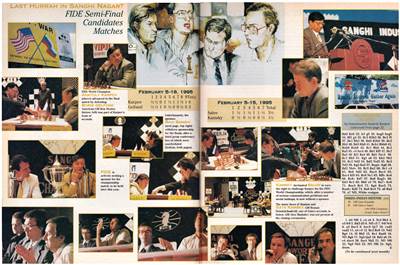
Karpov's column discussed games from the Kamsky - Salov match, won by Kamsky and thereby qualifying him into the title match. The column was 'continued' in the same issue of Chess Life, a two page report titled 'Sanghi Nagar, photo essay by Bill Hook', pictured in full below.


Chess Life, June 1995, p.46-47

The Bill Hook report was the only CL report on that stage of the FIDE Candidates Matches, where an American qualified into a World Championship title match. Karpov's column for the following month discussed his match with Gelfand, who was eliminated for the title match.

CL 1995-07 Sanghi Nagar, Part II

[Nothing special to highlight]

We've already seen a high level look at the title match by CL on my main blog in May 1970 & 1995 'On the Cover' (May 2020). Where can we find more detail about the two Sanghi Nagar events?

30 October 2019

2019 Grand Swiss Results

I added the crosstable to my page on the 2019 Grand Swiss; Isle of Man. Still to be done are adding the PGN and updating the Index of Players. In the previous post, 2019 World Cup Regulations, I wrote,

I started the process of adding a crosstable to my page for the 2019 Grand Swiss, which finished this week. While preparing the PGN, I counted 154 players and 841 games. [...] One question I haven't answered is how to update the index of players. I imagine that many players who participated in the Grand Swiss will never play in another World Championship event. Is it worthwhile adding their names to the index? I'll have to count the number of new players before I decide how to proceed.

A preliminary count gave 38 new players, or about 25% of the 154 players who participated. This compares to the 30% (38/128) that I counted a few weeks ago in 2019 World Cup Players. That statistic gives me a green light to add all of the new players to the index. • NB: The qualification paths for the participants are documented in FIDE Chess.com Grand Swiss Preview (chess.com; Peter Doggers).

It's also worth mentioning two previous tournaments that were part of the FIDE World Championship cycle and that used the Swiss system format:-

These were the last Interzonals organized before the knockout format replaced the entire tail-end of the cycle.

29 May 2019

Zonal Qualifiers C13-C16

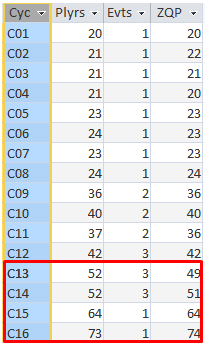
In the previous post, Zonal Qualifiers C01-C16, I started working with a summary of the qualifying paths from the zonal stage to the interzonal stage for the earliest World Championship cycles. On top of zonals, these paths included other means of seeding players into the Interzonals, like rating. To facilitate comparison, I created a table which is also shown near the end of today's post.
The table shows my count of the number of players who participated in the interzonals for C01 through C16. [...] The last column shows the number of players documented in the zonal material that I'm using as the base for this exercise. The table gives me a guide for further work on this particular project. [...] The new data lets me complete C01-C12 and also lets me doublecheck C13-C16.

The cycles C13-C16 took place during FIDE's darkest days. Let's have a recap of the interzonals that spanned nearly a decade.

C13 unfolded during the uncertainty of the first three Kasparov - Karpov (K-K) matches, when the continuity of the previous cycle (C12) had been disrupted and had entered uncharted territory. For C13, FIDE scrambled to organize something resembling a traditional cycle. There were three Interzonals that eventually led the way to the fourth K-K match.

C14 was played in (more-or-less) traditional circumstances. It was the last cycle to have three Interzonals. They culminated in the fifth K-K match, the last match between the two 'K's.

C15 saw the introduction of a single interzonal tournament using a Swiss system format instead of the traditional round-robin format. The cycle would eventually lead to the schism between FIDE and Kasparov, with two parallel World Championship matches.

C16 was played as the schism was deepening, with two parallel World Championship cycles. No one knew where world class chess was going.

The following chart is taken from the previous post, 'Zonal Qualifiers C01-C16', and highlights the four cycles featured in today's post. The counts show the approximate number of players who qualified into the interzonals for those cycles.

I compared the lists of players from my record of interzonals and the summary of zonal qualifying paths (ZQP). After identifying differences in the spelling of players' last names (needs more work to establish the accepted spelling) and accounting for the order of Asian names (like 'Qi Jinguan' and 'Jinguan Qi' in C13) I worked out the reason for the different numbers.

In C13 and C14, a total of four players were missing from the ZQP lists. C15 matched perfectly. C16 was due to a mismatch between my page on 1993 Biel and my Index of Players (they should also match); the ZQP data was perfect.

All things considered, I was pleased with the correlation between my data and the ZQP data. It was even better than I had hoped for and confirmed my belief that the ZQP data is an excellent source of info on the early FIDE zonals and interzonals.

05 August 2015

Zonal Qualifiers C15 - Qualification Paths

After completing the preliminary work described in my previous post, Regulations for Qualifiers C15, I tried to determine the qualification paths for each of the 64 players who competed in the 1990 Manila Interzonal. The two tables below show the counts of players who qualified by the different paths.

The left table ('Qual') counts the types of qualifiers as defined in the first part of Zonal Qualifiers 1990-1993 (C15). The right table ('Zonal') counts the players who qualified at a certain zonal ('z'), as listed in the second part of the same page.

At the same time I worked on the qualification paths, I added a few new clippings to Zonals 1990-1993 (C15). These are mainly explanations about players from specific zonals and I have a few more to add when I find the time.

The first row in the 'Qual' table counts eight players where I am not certain how they qualified. These are mainly players who were nominated by Continental Vice-Presidents (Qual = 'd').

Some of the counts in the 'Zonal' table are also likely to be wrong. Zone 4 (USSR) reportedly had six qualifiers from the zonal, but I can only identify five. Zone 8 (Central America) shows three qualifiers, but one of these might have been the nomination of the Continental Vice-President.

Whatever the real status of my tables and counts, they give a good basis for further investigation. Before I pursue that, I would like to incorporate the dozen new pages showing Qualification Paths into the rest of my material on the zonals.

29 July 2015

Regulations for Qualifiers C15

After working on Zonal Qualifiers C16 - Qualification Paths, I turned my attention to the 1990 Manila Interzonal Tournament. I found an overview of the regulations to determine qualified players and started a new page, Zonal Qualifiers 1990-1993 (C15).

The list of players competing in the Interzonal, plus the regulations, plus the details on the Zonals 1990-1993 (C15), should allow me to identify how most of the players qualified for the 1990 Interzonal. I'll work on that for my next post.

31 July 2013

Averbakh on the World Championship

In yesterday's post on my main blog, Friendly Chess Players, I introduced Averbakh's 'Centre-Stage and Behind the Scenes: A Personal Memoir'. The book is filled with stories about the World Championship, some of them new to me, many of them in more detail than I've seen before. Here's a list, each entry starting with its first page number in the book.

059 : 1950 CT
063 : 1951 19th USSR Chp semifinal (pre-zonal)
064 : ---- Pen portraits (A)
070 : 1951 19th USSR Chp (zonal)
071 : 1952 IZ
078 : 1953 CT
092 : 1955 22nd USSR Chp (zonal)
100 : ---- Sparring partner to MB
108 : 1958 25th USSR Chp (zonal)
110 : 1958 IZ
112 : ---- Early rules for WCC
120 : 1959 CT
129 : 1962 CT
147 : 1968 IZ playoff
154 : 1971 CM: TP-VK, RF-TP
157 : ---- Baturinsky
163 : 1972 WC: RF-BS
164 : 1963 VS & zonal
166 : 1974 CM: TP-LP, VK-TP
169 : 1977 CM: VK-TP
171 : 1974 FIDE Congress: AK-RF
175 : 1974 CM: AK-VK
178 : 1976 VK defection
185 : 1978 WC: AK-VK, Sevastianov
190 : 1982 IZ
193 : 1972 WC: RF-BS, Euwe
194 : 1982 FIDE President Campomanes
199 : 1982 CM: VS-RH, VS-ZR, GK-VK
214 : 1984 WC: AK-GK I
220 : 1985 WC: GK-AK II
221 : 1986 WC: GK-AK III
223 : 1987 FIDE Presidential election, GMA
223 : 1987 WC: GK-AK IV
224 : 1988 USSR Chp, GK-AK playoff
227 : 1988 USSR vs. World charity match
229 : 1990 Women's CT, Krogius
232 : 1972 Graz, Huebner - Rogoff (B)
233 : 1990 FIDE Presidential election
235 : 1987 GMA
236 : ---- Chess psychology (C)
240 : 1982 OL: Manila
242 : 1993 Schism, PCA, GK-NS, AK-JT
247 : 1994 OL: Salonika -> Moscow
250 : 1994 FIDE Presidential election
251 : 1995 FIDE Congress, Paris, Ilyumzhinov

IZ: Interzonal
CT: Candidate Tournament
CM: Candidate Match
WC: World Championship
OL: Olympiad (esp. Congress++)

AK: Karpov, BS: Spassky, GK: Kasparov, JT: Timman, LP: Portisch, MB: Botvinnik, NS: Short, RF: Fischer, RH: Huebner, TP: Petrosian, VK: Korchnoi, VS: Smyslov, ZR: Ribli

(A) Zubarev, Blumenfeld, Duz-Khotimirsky, Rabinovich, Verlinsky, Romanovsky
(B) A little known story about the future IMF Chief Economist; nothing to do with WC
(C) Incl. six categories of player as in 'Friendly Chess Players'

Although Averbakh's book deserves a review on my blog, this summary will have to do for now.

11 May 2011

Meet Cathy Forbes

I picked up a used copy of 'Meet the Masters' by Cathy Forbes (Tournament Chess, 1994) and was pleasantly surprised to discover that it was largely about the World Championship in the early 1990s. Mixed in with other luminaries, it has interviews with Keene, Fischer, Kasparov, Short, and Timman, plus Xie Jun; only Karpov is missing. I had already read Forbes' works on the Polgar sisters (Batsford, 1992) and Nigel Short (Cadogan, 1993), and knew that she was a keen observer of top level chess. For more about the author, see Cathy Warwick (née Forbes; Wikipedia); for a sample of her work, see Bobby Fischer, the Holy Grail - A Balkan Odyssey.

30 March 2011

Zonals & Bad Championships

Using two recent summaries as a guide -- The U.S. Championship as FIDE Qualifier and Zonals : Links (and Other References) -- I updated my index of World Chess Championship Zonals. The last five cycles are now more accurate than they are misleading, largely due to the Zonals : Links records taken from ratings.fide.com, a wonderful resource for chess history that I only discovered while working on the zonals project. If you've never used it before, try entering a name, e.g. Seattle, in the box titled 'Archive Tournaments Database'.

***

Working on cycle 21 -- that's the one that culminated in the 2004 Tripoli KO -- prompted me to write The Worst World Championship Ever on my main blog. After I posted it, I started thinking that maybe it wasn't really the 'Worst World Championship Ever'. The aborted 1975 Fischer - Karpov match and the terminated 1984 Karpov - Kasparov match are two other strong choices, not to mention the nearly-abandoned 1993 Karpov - Timman match. I just realized that all three of those matches featured the same player. Now that's a coincidence!

17 November 2010

Kasparov on Modern Chess

The gremlins working at my website server host decided this would be a good time to take FTP out of service, so I'm temporarily blocked from making any updates to my site. Instead of continuing with my zonal page (last seen in Zonal Cycle 2004-2005), I have to punt. Looking at the ongoing list of possible topics (a long list), I see several reviews of Kasparov's series on Modern Chess, but no one source appears to have covered them all. While I'm not a big fan of Amazon customer reviews, they'll have to do.

Garry Kasparov on Modern Chess (Amazon.com):

I started this topic in a previous post, Kasparov vs. Karpov 1975-1985, where I included the 'Sales Rank'. Although it's now called the 'Amazon Bestsellers Rank', I guess it's the same thing and have included the numbers for comparison. Revolution in the 70's has gone from #264,777 to #150,712. Way to go, Garry!

16 September 2009

K-K VI VII VIII IX?

Chessninja.com reported it in July: Kasparov, Obama, Karpov; Chessbase.com picked up on it in August: Karpov - Kasparov: Grudge Match in Valencia; now that we're in September, the next match between the two greatest rivals in chess history starts in a few days.

I was planning to put together a summary of K-K's openings from the five World Championship matches, but then discovered that I'd already done one (in 1999!): The Great Rivalries, Kasparov - Karpov. As for their overall record: Chessgames.com informs that in the 190 games they have played together (CG.com's number, not confirmed), Garry Kasparov beat Anatoli Karpov 31 to 23, with 136 draws. • But wait, there's more to come: Kasparov Karpov Paris 2009!