Showing posts with label C10: 1976-78. Show all posts

19 February 2025

Feedback on C10 Zonals

During the six months of inactivity mentioned in my recent post, Now I'm Here (January 2025), I received a number of relevant comments about my pages, some of them requiring non-trivial updates to those pages. The first such comment was the continuation of an older email exchange, titled 'Arandjelovac 1976'. It started,
I have investigated the cycle 1975-1978 and I can comment some facts.

The updates, to two related pages, are marked with the initials of the correspondent 'VA' [Vladica Andrejic] on those pages:-

VA concluded his comment saying,

I hope that this helps. I cover Interzonals (and some zonals) with some info written in Serbian here:

Your favorite online language translator will reveal the secrets of those two pages, which are similar. Thanks, VA!

14 April 2021

1976 Arandjelovac Zonal Revisited

My index of zonal pages, The World Chess Championship : Zonals, follows a straightforward structure. Players in a zone assemble for a tournament, they play each other, and the winners qualify into an Interzonal. Repeat that sequence for as many zones as were authorized for a particular cycle.

Sometimes the evolution of a zonal is not so straightforward. One example is documented on my page (C05) 1960-1963 Zonal Cycle, where the zone two tournament at Berg en Dal was annulled and played again the following year at Marianske Lazne. The underlying reason had to do with Cold War Chess Politics (July 2015).

Another such cold war event involved two zonals, 1975 Barcelona & 1976 Arandjelovac (August 2014). I outlined the circumstances in that blog post, but there's more to the story. Vladica Andrejic of Perpetualcheck.com, sent me scans of the following clippings, which tell the tale of 1976 Arandjelovac.


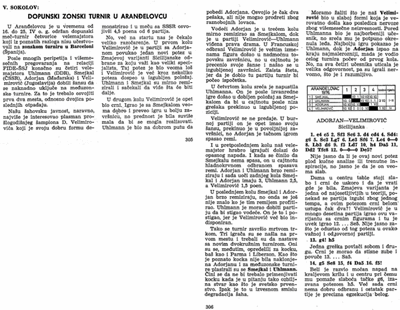
Šahovski glasnik, 1976-09, p.305-306

I ran the scans through (1) an OCR to text converter, followed by (2) a language translator, and was pleased enough with the results that I'll incorporate them here. The article, written by V. Sokolov, is titled 'Supplementary Zone Tournament in Arandelovac'. The first two paragraphs [with some minor edits by me] say,

It is in Arandelovac at the time of 16. to 25. [April] o. g. held supplementary match-tournament of four grandmasters who for obvious reasons did not participate in the zonal tournament in Barcelona (Spain).

After many vicissitudes and months of negotiations on the route FIDE-SSJ ['ŠSJ' = 'Šahovski Savez Jugoslavije' = Yugoslavian Chess Federation] finally four grandmasters Uhlmann (DDR), Smejkal (CSSR), Adorjan (Hungary) and Velimirovic (Yugoslavia) got a chance to [be] subsequently included in interzone tournaments. It needed to be won the first two places, i.e. the last two are dropped.

The next eight paragraphs describe the evolution of the tournament, especially taken from the point of view of Velimirovic. Unfortunately for his Yugoslav fans, he had a poor tournament and finished last behind the other three players who finished tied for 1st-3rd. The next paragraph says,

So the tournament ended in a dead race. Three players found themselves in the first place and should have continued with a new two-round tournament. They have, however, opted for gambling, just like Parma and Liberzon. Such as it is known that the dice were not in favor of Adorjan, [so] Smejkal and Uhlmann were placed for interzone tournaments. It seems that it should not be applied gambling when it comes to such a serious matter as the World [Championship]. Yet it is in a sense chess degradation.

I added the crosstable shown in the clipping to the page (C10) 1975-1978 Zonal Cycle, then reorganized the page to clarify the different sequences of events. There are still some open questions involving the 'IZ Qualifiers', but perhaps 'Šahovski glasnik' will prove useful there as well.

07 April 2021

Viktor and Petra Korchnoi

A couple of recent reports from the mainstream chess press have their roots in a World Championship match from the 1970s. It's curious that all three title matches from the 1970s -- 1972, 1975 (unplayed), 1978 -- have achieved legendary status.

2021-03-23: 'The dirtiest chess match in history': Stean on Karpov-Korchnoi, 1978 (chess24.com; Colin McGourty)

The great Viktor Korchnoi, one of the strongest players never to become World Champion, would have turned 90 today. On the eve of that anniversary, the BBC dedicated an episode of the radio broadcast Witness History to the match that saw Viktor come within a win of claiming the World Championship title. The clash with Anatoly Karpov in Baguio City in the Philippines is described as "a surreal experience" by English Grandmaster Michael Stean, who turned 25 during the match and was working as a second for Viktor.

2021-03-19: Petra Korchnoi dies at 93 (chessbase.com; Frederic Friedel)

It is with great sadness that we announce the death of Petra Korchnoi – Petronella Leeuwerik before her marriage to the two-fold World Championship Challenger. She was a remarkable personality and a great friend, and will be sorely missed.

More than 20 years ago I used database techniques to compile a summary of the many themes that occurred in the match: 1978 Karpov - Korchnoi Title Match : Yogurt, Parapsychology, Ananda Marga, ... (m-w.com). That analysis still holds up today.

02 December 2020

Karpov on the Rock

Earlier this year, for a featured monthly video on my main blog, I chose Retro Engine Chess (February 2020). There was another good choice, but it had already so many views and comments that I decided not to use it. It popped up on my radar again this past week, and it's too good to ignore a second time.


"I wanted to defeat Bobby" | GM Anatoly Karpov Interview (20:20) • '[Published on] Jan 29, 2020'

The GibChess description said,

A candid interview with former World Champion Anatoly Karpov. The Russian GM shares stories and reflections on his chess career with Tania Sachdev. Special thanks to Chess Base India.

For a transcript of the video, see Karpov on Fischer, Korchnoi, Kasparov and the chess world today (chessbase.com). For a related Youtube video, this one from GBC News and with far fewer views, see Former Official Chess World Champion Anatoly Karpov on the Rock. Its description said,

Former Official Chess World Champion Anatoly Karpov is visiting the Rock as part of the Gibraltar International Chess Festival. Considered one of the greatest players in history, he's the third longest world champion, behind Magnus Carlsen and Garry Kasparov. Christine Vasquez took the opportunity of gaining an insight into current developments in Russian politics but first asked Mr Karpov how he felt to be on the Rock supporting the Chess festival.

Change 'third longest world champion' to 'third longest world champion in post-WWII times' and I'll say no more, even though Carlsen hasn't (yet) caught up with Karpov.

24 July 2019

Zonal Qualifiers C09-C12

At the end of the previous post, Zonal Qualifiers C11, I concluded,
I've decided that the format of the data in the chart is sufficient for new zonal pages on my World Championship site.

I applied the format to four cycles and created four new pages:-

These pages show only the qualifier data. The other bells and whistles found on the existing pages, like (C13) 1984-1987 Zonal Cycle Qualifiers, will be added after I create similar pages for C01 through C08.

28 June 2017

Spassky: 'The Dr. Zhivago of Chess'

In a recent post on my main blog, Sports Illustrated 'On the Cover', I showed that a prominent American sports magazine ('SI') once demonstrated a keen interest in chess. Through the series of Kasparov - Karpov clashes in the 1980s, SI had regular, multi-page features on top World Championship events. Here, for example, are the first two pages of a five-page spread on the Korchnoi - Spassky final in the 1976-78 Candidates Matches.


Sports Illustrated, 12 December 1977

The article started,

With the notable exception of Bobby Fischer, who won the world championship from Boris Spassky in 1972 in a memorable Icelandic psychodrama, Soviets have dominated world chess for 30 years. And their reign is not about to end. This week, in the shabby elegance of the Dom Sindikata Theater in Belgrade, Yugoslavia, two Russians, Spassky and Viktor Korchnoi, are meeting for the right to play still another Russian, 26-year-old world champion Anatoly Karpov, for the title.

Spassky is now 40, and his figure, which was trim in Reykjavik, is a bit fleshier, his dark hair longer and more styled. But the same calm green eyes study the board, and the same long artistic fingers are placed along his cheekbones. The world champion from 1969 to 1972, Spassky remains the gentlemanly, dignified, poetic grand master, the Dr. Zhivago of chess.

Across the board sits the volatile, daring Korchnoi, 46, the world's No. 2 grand master. In further contrast to Spassky, the formerly chubby Korchnoi has lost a great deal of weight recently. His brown eyes glitter, his shoulders hunch as he lunges forward to advance a bishop into dangerous territory. Korchnoi seeks the dangerous position -- in life as well as at the chessboard.

That's the sort of colorful sports reporting that is seldom seen outside of the mainstream press. Here is a list of all SI articles on the World Championship that I was able to locate.

  • 1960-04-18: A New Moscow Revolution • 'Mikhail Tal's brilliant and bewildering victories in world championship chess stunned the Russians'
  • 1960-05-30: A Nod for a Title • 'Sports Illustrated's correspondent in Moscow reports on the new world chess champion Mikhail Tal and on the new chess era that opened with a smile'
  • 1961-05-08: The Young Botvinnik • 'An aging champion created a new training technique to recover the fire of youth -- and his title'
  • 1967-11-20: The Further Adventures of Terrible-tempered Bobby • 'Bobby Fischer played like a champion at the international tournament in Tunisia, but he ended by forfeiting his way out of the competition'
  • 1971-08-02: Maybe You Can Win Them All • 'Bobby Fischer has pitched 19 no-hitters in a row'
  • 1971-11-08: Bobby Clears the Board for the Title • 'The young U.S. master, after Tigran Petrosian smashed his 20-game streak, closed strong to earn a shot at the world's chess champion'
  • 1972-07-10 A Sudden Stalemate in Reykjavik • 'The world championship was plunged into check when Bobby Fischer decided that a better game was hide-and-seek'
  • 1972-07-24: Boris in Wonderland • 'Russia's Spassky played Alice to Bobby Fischer's Mad Hatter in Reykjavik last week'
  • 1972-08-14: How to Cook a Russian Goose • 'First, catch a Russian -- and at long last Bobby Fischer apparently has, dominating Boris Spassky so completely...'
  • 1974-01-28: Memo from Moscow: don't get byrned • 'Hot on his world chess championship comeback, Boris Spassky faces a scholarly and unintimidated American'
  • 1974-09-30: A Case of Beauty Before Age • 'Two Russians are meeting to see who will take on Bobby Fischer...'
  • 1977-12-12: Taut Duel for Two Old Comrades • 'They grew up together in Russia and meet again for the right to face the champion, but one is a defector, the other an émigré'
  • 1978-01-30: They Couldn't Zap the Viktor • 'Korchnoi came out of his match with Spassky smiling and ready for world champion Karpov, but in Belgrade he was grimly convinced that the Soviet KGB was bombarding him with rays'
  • 1978-07-31: Back to Drawing Old Board • 'The Soviet champ and a vocal defector drew the first three games of what could be a drawn-out world championship'
  • 1985-02-25: A Dubious Gambit In Moscow • 'Just when chess champion Anatoly Karpov seemed to be weakening, the challenger was abruptly checkmated'
  • 1986-11-13: Beating Back A Game Challenge • 'Anatoly Karpov played valiantly in their Leningrad showdown, but Gary Kasparov outlasted his rival to retain the world chess championship'
  • 1987-12-07: Duel Of Two Minds • 'Opposites Gary Kasparov and Anatoly Karpov battle for the world chess title'
  • 2016-11-12: Chess Pieces of History • 'Board in 1972 battle up for auction'

The reports aren't always perfect. There is sometimes confusion between the concepts of 'game' and 'match' that is irksome to many chess fans, and the 1971 baseball analogy...

Maybe You Can Win Them All • 'Bobby Fischer has pitched 19 no-hitters in a row'

...is clearly an exaggeration. Even with those nitpicks, I'll gladly accept a slightly flawed report that promotes chess to a non-chess readership. For some reason, the World Championship reports stopped after the 1980s. Was it because of a changing perception of chess as a sport, because of the political turmoil in the chess world, or because of something else? I would really like to know.

13 January 2016

Zt: 1987 Jakarta

In a recent post, Zonal Qualifiers C14, I was reminded of an outstanding zonal mystery, the 1987 Jakarta event for FIDE zone 11. Although the word 'scandal' is attached to the zonal, I had never seen any detailed explanation of what happened there. In particular, did the scandal have an impact on who qualified to the subsequent Interzonals?

Thanks to IndonesiaBase, there is an entire page describing the event, FIDE Zonal 11, Bogor/Jakarta 1987, including copies of letters from the players complaining about alleged collusion among the Chinese players. The page informs,

The combination of the unethical play, the fact that China had four out of twelve finalists, and the carry-through system damaged the tournament so badly to the extent of beyond repairable. GM Ian Rogers was the first player to pull out as a protest. GM Utut Adianto and GM Rosendo Balinas Jr were the next ones to do so.

Prof Dr Max Arie Wotulo, the President of FIDE Zonal 11 and an IM himself, agreed. He declared that the final stage was void. The twelve finalists were expected to be at Jakarta in May to replay the final stage. However, for a mysterious reason, the FIDE governing body ruled out this decision and endorsed the top two of the event, Chinese Xu Jun and Filipino GM Eugenio Torre, as the Zonal 11 representatives to Interzonal Championship. Case closed.

I added clippings for the IndonesiaBase crosstables and explanations to my page on (C14) 1987-1990 Zonal Cycle. Add this event to the list of bizarre zonals: 1960 Berg en Dal (as in Cold War Chess Politics) and 1975 Barcelona / 1976 Arandjelovac.

06 August 2014

Zt: 1975 Barcelona & 1976 Arandjelovac (II)

After posting about two controversial events in the 1975-1978 cycle -- see Zt: 1975 Barcelona & 1976 Arandjelovac -- I received more information from two Czech correspondents, both keen chess historians.

The first correspondent, Jan Kalendovský, confirmed that both Smejkal and Uhlmann qualified from 1976 Arandjelovac for the Interzonal phase after the drawing of lots. He also forwarded a column by GM Hort from a May 1976 issue of Rudé právo which discussed the outcome. I added the clipping to my page on the cycle, Zonals 1975-1978 (C10).

Rudé právo (Czech for The Red Right or The Red Law) was the official newspaper of the Communist Party of Czechoslovakia. • Rudé právo [Wikipedia]

The second correspondent, Jan Fiala, commented on the circumstances surrounding the boycott of 1975 Barcelona.

The theory about Pachman is possible. Two chessplayers in the 1970s couldn't play for two years because they played in one tournament with Pachman -- Ján Báňas and Ivan Novák, Stockholm 1974 -- but I didn't read about it anywhere [else]. Moreover, Smejkal in his memories in one interview wrote about it and I think if it was because of Pachman, he would say so.

He also forwarded a translated excerpt from 'Jan Smejkal - Bretislav Modr: Smejkalova padesatka, Sachinfo 4/1996, page 136'.

In time when I was on top and I saw the whole world pink, I should play in next cycle zonal tournament in Spain (in year 1975) and I did not. The day before take-off a telegrame came that tour is not held. And a declaration was published without our knowledge together with Yugoslavians, Poles and Hungarians in which we protest against Franco's regime.

Zonal tournament was held and Ludek Pachman, who lived in Germany yet, promoted [i.e. 'qualified'] amongst others. [...] Finally I promoted to interzonal, together with interest of Russians and Americans but also of organizers of interzonal tournaments and next promoting places were enforced for those who could not start in Barcelona. I promoted but without illusions.

Jan Kalendovský is a published author; see Complete Games of Alekhine on newinchess.com. Jan Fiala maintains a web page on Czech chess history at sachyceskybrod.cz/historie.htm. Thanks to both for the information.

***

Later: I added another clipping, received from the same correspondents, to the 1975-1978 (C10) page. It's under the heading 'Barcelona 1975', captioned 'Rudé Právo 1975-10-03'. A translation was also provided:-

As a Protest Against Reprisals • Yugoslavian chess master D. Velimirovic anounced to FIDE secretariat that he will not take part in zonal tournament in Barcelona as a protest against fascist regime in Spain. At the same time he asks international federation to replace the tournament to other European country.

The correspondents mentioned that there were other published protests.

02 July 2014

Zt: 1975 Barcelona & 1976 Arandjelovac

When it comes to chess history, one thing generally leads to another, and a particular subject is often incomplete. While I was working on the actions identified in Zonal Overview 2013 (plus the following three weeks), I discovered a curious paragraph on Zonals 1990-1993 (C15). A clipping for zone 3, Stara Zagora 1990-02, mentioned
The zone of Europe is one of the strongest, and used to send representatives to compete with the rest of Europe till the Pachman affair and the orders of now discredited governments led to tournament disruption. [BCM, 1990-05, p.197]

Pachman affair? What was that all about? Looking at my index page for World Chess Championship Zonals, I identified the 1975 zonals as the likely root of the 'affair', especially two events: 1975 Barcelona and 1976 Arandjelovac. Pachman played in the first event and the the second was a mystery to me that I had investigated several times without much success. The clippings for that cycle, including notes from a relevant discussion with 'EK', are on my page for Zonals 1975-1978 (C10).

A copy of a Pachman obituary from Google groups -- Ludek Pachman, chess grandmaster; Telegraph obit -- gave me further details.

In 1975 Pachman qualified once again for a world championship zonal tournament, this time held in Barcelona. After his departure from Czechoslovakia, East European chess federations had done their utmost to continue damaging his career, and they now used the bullying tactic of threatening a total Eastern European boycott if he took up his place.

Fortunately, the Spanish organisers and the World Chess Federation stood their ground. Pachman's invitation remained and it was the communist players who suffered, by being deliberately excluded from the event. As it was, he went on to qualify, and his presence in the 1976 interzonal contest obliged the communist federations to abandon their boycott, since to have withdrawn en masse from this advanced stage of the world championship would have been a considerable political setback.

This was confirmed in a passage from the book 'Smart Chip from St. Petersburg' by Genna Sosonko, in a chapter titled 'If the Trumpet Sounds; Ludek Pachman (1924-2003)'.

A few months later, in August 1975, we both played in the zonal in Barcelona. This was an unusual tournament. About ten days before it began in Spain —- where Franco was in power at the time -- several people were sentenced to death for killing a policeman. When we arrived in the capital of Catalonia we found out that some representatives of Eastern European countries -- strong grandmasters from Yugoslavia and Czechoslovakia -- had refused to come to the tournament in protest, while the Romanian and Hungarian chess players had arrived in Barcelona but eventually decided not to play because they were afraid of being punished by their governments when they returned home. [p.52]

The reason for the boycott is different for the two accounts, but the underlying facts correlate nicely. A little further investigation led me to a long discussion on Chessgames.com's Biographer Bistro. It starts,

Jan-26-14 thomastonk: I see. Some Dutch newspapers also reported on the zonal in Barcelona because of Sosonko. Three places for the interzonals, one newspaper says two. Four strong players from eastern Europe did not start because of Sosonko and Pachman. Diez del Coral is mentioned as second, and since Pachman played in Manila, he should have been qualified, too.

The discussion is too long to quote in its entirety, but it did tie 1975 Barcelona to 1976 Arandjelovac.

Jan-26-14 sneaky pete: In Barcelona 1975 not 4 but 6 masters from eastern Europe (Adorjan, Ciocaltea, Smejkal, Uhlmann, Velimirovic and Ermenkov) were not allowed to play by their federation because of some recent murders of political opponents committed by the Franco gang. The Swedish master Ornstein didn't play for the same reason (the murders).

Four of the 6 eastern Eastern masters later played a double round qualifier for 2 places, where of course 3 players shared first place. After drawing of lots Smejkal and Uhlmann qualifed at the expense of Adorjan. Velimirovic was number four.

There are more leads here for further investigation, especially the qualification process for the two subsequent Interzonals, but that isn't too surprising. 'When it comes to chess history, one thing generally leads to another, and a particular subject is often incomplete.'

***

Later: Some quotes from the Chessgames.com reference for further investigation:-

  • A) 1975 Barcelona : 'The Swedish master Ornstein didn't play for the same reason (the murders).'
  • B) 1976 Arandjelovac : 'After drawing of lots Smejkal and Uhlmann qualifed at the expense of Adorjan.'
  • C) IZ Qualifiers : 'Diez del Corral couln't play because of professional obligations and was replaced by first reserve Pachman.'
  • D) IZ Qualifiers : 'Perhaps only one place [from 1976 Arandjelovac] because Smejkal was already qualified from the Leningrad Interzonal (1973). As was Larsen, Kuzmin (who withdrew), Hübner, and somehow Tal (possibly as reserve for Kuzmin).'
  • E) IZ Qualifiers : '"EK" in http://www.mark-weeks.com/chess/zon... (bottom of page) writes that Smejkal was 2nd reserve and that Kuzmin was replaced by Kavalek etc., but I'd like to see hard evidence.'
  • F) IZ Qualifiers : 'The British Chess Magazine, issue May 1976, page 184, reports on the results of a FIDE Bureau meeting in Rome, March 16-19.'
  • G) IZ Qualifiers : 'When FIDE decided to create 2 extra places to give the Barcelona five (originally six) a second chance, they also added 2 more places (for a reserve from the previous cycle and a Swiss guest player)'

The BCM reference (F) looks to be extremely useful.

31 July 2013

Averbakh on the World Championship

In yesterday's post on my main blog, Friendly Chess Players, I introduced Averbakh's 'Centre-Stage and Behind the Scenes: A Personal Memoir'. The book is filled with stories about the World Championship, some of them new to me, many of them in more detail than I've seen before. Here's a list, each entry starting with its first page number in the book.

059 : 1950 CT
063 : 1951 19th USSR Chp semifinal (pre-zonal)
064 : ---- Pen portraits (A)
070 : 1951 19th USSR Chp (zonal)
071 : 1952 IZ
078 : 1953 CT
092 : 1955 22nd USSR Chp (zonal)
100 : ---- Sparring partner to MB
108 : 1958 25th USSR Chp (zonal)
110 : 1958 IZ
112 : ---- Early rules for WCC
120 : 1959 CT
129 : 1962 CT
147 : 1968 IZ playoff
154 : 1971 CM: TP-VK, RF-TP
157 : ---- Baturinsky
163 : 1972 WC: RF-BS
164 : 1963 VS & zonal
166 : 1974 CM: TP-LP, VK-TP
169 : 1977 CM: VK-TP
171 : 1974 FIDE Congress: AK-RF
175 : 1974 CM: AK-VK
178 : 1976 VK defection
185 : 1978 WC: AK-VK, Sevastianov
190 : 1982 IZ
193 : 1972 WC: RF-BS, Euwe
194 : 1982 FIDE President Campomanes
199 : 1982 CM: VS-RH, VS-ZR, GK-VK
214 : 1984 WC: AK-GK I
220 : 1985 WC: GK-AK II
221 : 1986 WC: GK-AK III
223 : 1987 FIDE Presidential election, GMA
223 : 1987 WC: GK-AK IV
224 : 1988 USSR Chp, GK-AK playoff
227 : 1988 USSR vs. World charity match
229 : 1990 Women's CT, Krogius
232 : 1972 Graz, Huebner - Rogoff (B)
233 : 1990 FIDE Presidential election
235 : 1987 GMA
236 : ---- Chess psychology (C)
240 : 1982 OL: Manila
242 : 1993 Schism, PCA, GK-NS, AK-JT
247 : 1994 OL: Salonika -> Moscow
250 : 1994 FIDE Presidential election
251 : 1995 FIDE Congress, Paris, Ilyumzhinov

IZ: Interzonal
CT: Candidate Tournament
CM: Candidate Match
WC: World Championship
OL: Olympiad (esp. Congress++)

AK: Karpov, BS: Spassky, GK: Kasparov, JT: Timman, LP: Portisch, MB: Botvinnik, NS: Short, RF: Fischer, RH: Huebner, TP: Petrosian, VK: Korchnoi, VS: Smyslov, ZR: Ribli

(A) Zubarev, Blumenfeld, Duz-Khotimirsky, Rabinovich, Verlinsky, Romanovsky
(B) A little known story about the future IMF Chief Economist; nothing to do with WC
(C) Incl. six categories of player as in 'Friendly Chess Players'

Although Averbakh's book deserves a review on my blog, this summary will have to do for now.

19 September 2012

The Philippine Connection

While writing yesterday's post on my main blog, The Match That Never Was, I had a vague recollection of another fabricated Fischer - Karpov game from a few years ago. Sure enough, I found it on Chessbase.com and added the relevant links to the 'Never Was' post.
One unfabricated fact about the game didn't seem right: that the main negotiations between Fischer and Karpov occurred in the Philippines. The one reference by Chessbase -- Russians vs. Fischer, by Plisetsky and Voronkov (1994), p.366-367 -- mentions only meetings in Tokyo and Cordoba. Then I turned to Kasparov's volume on Fischer, My Great Predecessors IV, where starting on p.467, there is a long, detailed account titled 'Abdication'. Here is a timeline derived from that account.

1972-09Reykjavik: Fischer wins title from Spassky
1972 San Antonio: Fischer visits tournament; meets Karpov for first time
1973 Manila: Fischer visits tournament; meets Marcos, Campomanes
1973-09Helsinki: FIDE Congress, Fred Cramer presents Fischer's proposals
1974-06Nice: FIDE Congress; Fischer resigns title
1974-11Moscow: Karpov beats Korchnoi in Candidates final
1975-01Philippines offers $5.000.000 for match
1975-03Bergen-aan-Zee, Holland: Extraordinary FIDE Congress
1975-04Euwe declares Karpov World Champion


1974(?)Campomanes takes role of intermediary between Fischer & Karpov
1976-07Tokyo: First negotiations
1976-08Cordoba: Next meeting
1977-10Washington: (1) restaurant, (2) Philippine embassy

There are some gaps in that table, especially months and venues, which I'll fill in from other accounts.

16 March 2011

Names: Certainty and Uncertainty

Now that the results are in for the 2009-2010 Women's Grand Prix, Doha, the final event in the 2009-2010 FIDE Women's Grand Prix, I added the players to the Index of Women Players for all women's events.

Although no format has yet been announced for the next cycle (2011-?) of the unrestricted World Championship, it appears from my recent post 2010 FIDE General Assembly : Whither the World Championship?, that it will follow the same World Cup -> Candidates -> Title Match format being used for the current cycle (2008-12?). This means that the unrestricted World Championship and the Women's World Championship will be using different formats: a three year cycle (my best guess) and a two year cycle (according to FIDE's announced plans). Let's see which format succeeds better.

***

By coincidence, I recently received a couple of emails related to Korchnoi's matches from the 1970s. The first asked for clarification on where the 1974 Korchnoi - Mecking quarterfinal candidates match had been held, so I added a detail to my page on the 1973-75 Candidates Matches. This reminded me that I still have a number of historical matches which lack the month when the match was played. The second email was about a paragraph in my page on the 1978 Karpov - Korchnoi Title Match, titled Yogurt, Parapsychology, Ananda Marga, ... Where I had written,

When play resumed for game 18, Rita Mataragnon, who worked for [a professor in the Department of Psychology at Manila University, Dr. Jaime] Bulatao, was present in Baguio, seated in the fifth row. Luc Claes, another associate of Bulatao, was present for game 19, along with groups of young psychology students. Karpov sent a letter to Schmid after game 20 complaining about the students.

I learned that the real identity of the person named Luc Claes is not at all certain. I rewrote the paragraph to reflect the uncertainty.

***

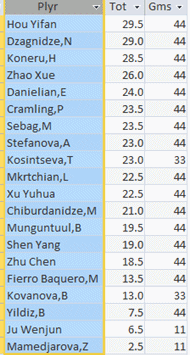
Later: Following up a subsequent idea, outlined in 2015-2016 Women's Grand Prix, the Players (December 2016; 'The first two posts, 2009-2010 & 2011-2012, could use a chart like the one shown above.'), I added the chart shown on the left.

For each of the players who competed in the 2009-2010 Grand Prix, it shows the total score achieved and the number of games played by the player.