14 October 2020

'Tournir of the FIDE Applicants'

Spotted on the Russian language site chess-news.ru:-

If you're wondering about the English language titles on a Russian site, there's a simple explanation. I ran the orginal articles through Google's translation service. Here's how it translated the first few paragraphs of the first article, 'Wang Hao and FIDE':-

Wang Hao posted on his Facebook a letter from Arkady Dvorkovich to him. The FIDE President, according to the Chinese grandmaster, then asked him to publish all the correspondence. Wang Hao did that too.

The main correspondence is with FIDE lawyer Alexander Martynov . It is about the second round of the Candidates Tournament. From the letters it follows that FIDE is still considering two locations for the game - Yekaterinburg and Tbilisi, but is determined to resume the competition from November 1.

Today, October 5th, it is planned to make a final decision. However, Wang Hao (and possibly Ding Liren too) does not consider it correct to organize the tournament now for security reasons and suggests FIDE to postpone this matter until better, from an epidemiological point of view, times.

The rest of that article was a chain of emails written in English. As for the second article, 'Karpov to Dvorkovich', the translation was simpler:-

Anatoly Karpov sent a letter to Arkady Dvorkovich regarding the second round of the Candidates Tournament.

The rest of the article was a letter in Russian, in the form of an image, which Google didn't translate. I ran the letter through an OCR service, then ran the output Russian text through the Google translator. Here's what I got:-

TOURNf1R OF THE FIDR APPLICANTS. CHESS 2020
Axioms. Ssrligsvaya region, Yelagsriya, Surg
Prgzkhdeit of the International Chess Federation (FIDE) Dvorkovich A.V.

Dear Arkady Vladnmirovkhch!

In accordance with the Agreement between FIDE, FSHR and SHFSO, we had an excellent first part of the 2020 Tournament and went to a forced break due to pag1demiI at your decision. Ekatsriiburg has the unconditional right to host the rest of the tournament, which you noted in your letter to the First Deputy Governor of the Sverdlovsk Region, Chairman of the Organizing Committee of the Candidates' Tournament Orlov A.V. The continuation of the tournament in Ekatsrinburg was confirmed by the press secretary of the President of the Russian Federation, chairman of the board of trustees of the FSHR D.S. Peskov.

We have never waived our right to host a tournament in Ekaterhiburg. Therefore, the actions of the FIDE representatives, who are holding underground negotiations and putting pressure on the participants to move the tournament to another place, are surprising.

If the epidemic situation in the Sverdlovsk region does not allow the tournament to continue from November 1, 2020, then it can be held at a later date. Before the World Championship Match between Mapgus Karpsen x the winner of the Pretsidegp Tournament, postponed to mid-2021, there is enough time to spend the rest of the tournament in the same place as x the first half.

As the plenipotentiary representative of the Organizational Committee of the Candidates Tournament in Ekatsrieburg, I express my readiness to hold the second half of the tournament in any eventuality.

Mnogokragg1 world champion.
Member of the Organizing Committee of the
Candidates Tournament in Eka erinburg-2020

A.E. Karpov

There are plenty of errors in that OCR translation, and if I were doing a more formal article than this current post I would try to correct them, but the text makes sense as it is. It helps to know that 'applicants' in the first line and 'pretsidegp' in the third paragraph both stand for 'candidates'. The nonsense word 'pag1demiI' in the first paragraph must be 'pandemic'. As for 'Mapgus Karpsen', also in the third paragraph , the phrase 'World Championship Match between Mapgus...' should eliminate any confusion.

Getting back to the sentence, 'Today, October 5th, it is planned to make a final decision', almost ten days have passed. My previous post on the subject, Yekaterinburg Candidates - 2nd Half Announced (September 2020), noted,

Fide.com: 'The 8th round has been scheduled for 1 November 2020.'

Something's got to give!

07 October 2020

Early World Championship Tournament Play

Continuing with two posts on the early World Championships...

...in that second post I quoted H.J.R.Murray from his 'History of Chess'...

After 1860 the opinion that the Tournament was not the best way of discovering the strongest player of the day became general, and the match became the recognized test.

...and wondered...

On what evidence did [Murray] conclude that 'the opinion became general'? I'm afraid that might be looking for a needle in a haystack, but a good place to start would be the Early Chess Periodicals that I collected last year.

That 'Early Chess Periodicals' post leads to Tabulating the Rabbit Hole (June 2019), where I counted the number of early periodicals in my digital collection by year. For the 1860s, that totals 46 annual volumes; for the 1870s (through 1878), 14 volumes.

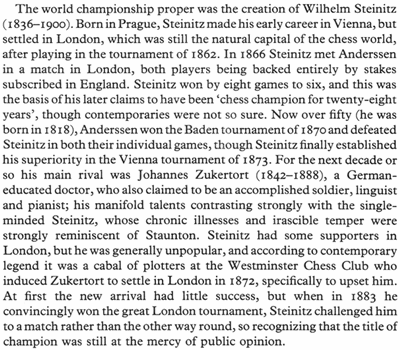
Since that is too many volumes for practical guidance, I turned to another good source, 'Chess: the History of a Game' by Richard Eales (Batsford, London, 1985), for further guidance. Here is a long paragraph from the book.


Eales p.152

There are two passages in that excerpt relevant to the issue of match vs. tournament play. The first is:-

In 1866 Steinitz met Anderssen in a match in London, both players being backed entirely by stakes subscribed in England. Steinitz won by eight games to six, and this was the basis of his later claims to have been 'chess champion for twenty-eight years', though contemporaries were not so sure. Now over fifty (he was born in 1818), Anderssen won the Baden tournament of 1870 and defeated Steinitz in both their individual games, though Steinitz finally established his superiority in the Vienna tournament of 1873.

The second is:-

When in 1883 [Zukertort] convincingly won the great London tournament, Steinitz challenged him to a match rather than the other way round, so recognizing that the title of champion was still at the mercy of public opinion.

The first passage mentions the 1870 and 1873 tournaments as having an influence on thinking about the early World Championship. Those are the same tournaments that I flagged in the 'Official Unofficial' post. The second passage mentions the 1883 tournament. Since I've already documented the 1883 event, perhaps I should look more closely at the two earlier events. The 'Tabulating' post counts only a handful of periodicals from the early 1870s. Even though they are in the German language, it's a manageable number.

One more thought: there must have been a 'list zero' of unofficial early World Championship events. Since an introduction to chess history consists of parroting what recognized historians have already documented -- that's how I started -- there must be a chain of lists of unofficial early events. Who compiled the first such lists? Where were they published or otherwise documented? Perhaps the first official World Championship, the 1886 Steinitz - Zukertort match, is a logical place to start looking.

30 September 2020

Early World Championship Match Play

In last week's post, Official Unofficial Early World Champions, I wondered about the importance of tournament play in the early history of the World Championships:-
After 1866, Steinitz played a number of matches with other players. Those matches are considered unofficial World Championships, but what about the tournaments that were held in the period 1866 to 1886. [...] What does H.J.R.Murray have to say about this subject. His 'History of Chess' first appeared in the early years of the official World Championship.

I found a copy of Murray's book on the Internet Archive: Full text of "A History of Chess". It identifies itself as:-

HISTORY OF CHESS • H.J.R.MURRAY • OXFORD • AT THE CLARENDON PRESS • 1913

On p.888, Murray wrote,

With the commencement of the era of magazines, tournaments, tourneys, and newspaper columns, I have reached the limit which I have prescribed for myself. I shall only add the. briefest of references to the crowded chess life of the last sixty years.

Before he signed off, Murray had a few paragraphs on the Anderssen era:-

With Anderssen’s triumph in the 1851 Tournament the supremacy of chess passed into German hands, and Germany might claim to be the first chess country of Europe. But circumstances had changed since the time of Philidor, and a claim of this kind, probably never really tenable at any time, had become an absurdity with the general rise in the standard or chess in all countries. The sceptre of chess was henceforward an individual, not a national possession.

That Anderssen’s victory was no chance one was made clear by his success in later Tournaments. Between 1851 and 1878 he took part in twelve Tournaments and his name appeared on the prize list in every one of them, while on seven occasions he won the first prize (London 1851 and 1862, Hamburg 1869, Barmen 1869, Baden 1870, Crefeld 1871, Leipzig 1876). But after 1860 the opinion that the Tournament was not the best way of discovering the strongest player of the day became general, and the match became the recognized test. [26] It was as a result of his match with Wilhelm Steinitz, in 1866, which he lost by 6 games to 8, that Anderssen’s supremacy is assumed to have come to an end.

From this I took away two main points. The first was a transition for any World Championship (as a concept) from a 'national possession' to an individual possession. The second was in the sentence that I repeat:-

After 1860 the opinion that the Tournament was not the best way of discovering the strongest player of the day became general, and the match became the recognized test.

Murray gave no references to support that statement; note '[26]' is irrelevant to the sentence in question. On what evidence did he conclude that 'the opinion became general'? I'm afraid that might be looking for a needle in a haystack, but a good place to start would be the Early Chess Periodicals (April 2019) that I collected last year.

23 September 2020

Official Unofficial Early World Champions

Last year I wrote a couple of posts on aspects of German master Adolf Anderssen's career:-

While I was working on those, I started to wonder how the list of early, unofficial World Champions originated. I imagine that someone started with Wilhelm Steinitz, the first official World Champion, then worked backwards. If so, who created the list and when?

E.G.Winter's, editor of the book 'World Chess Champions' (Pergamon Press, Oxford, 1981), included 16 chapters by 12 contributors. After the first chapter, titled 'Early times', the book had chapters on Staunton, Anderssen, and Morphy -- in that order -- followed by the World Champions that are usually numbered 1 to 12, i.e. no.1 Steinitz, no.2 Lasker, ... through no.12 Karpov.

The 'Early times' chapter was written by W.H.Cozens, who mentioned Ruy Lopez, Paolo Boi, Leonardo da Cutri, Greco, Philidor, and Deschapelles, all chronologically. To these he added Petroff, Cochrane, McDonnell, and La Bourdonnais.

Kasparov, in his five part 'My Great Predecessors', had 'Chess before Steinitz' as the first chapter of Part I. He mentioned Greco, Philidor, Deschapelles, Lewis, La Bourdonnais, McDonnell, Staunton, Saint-Amant, Anderssen, Kieseritzky, Morphy, Kolisch, Zukertort, and Paulsen.

In more recent times, others have carried the list even further back. Wikipedia's World Chess Championship lists 14 'Leading players before the World Chess Championships' from Ruy Lopez to Zukertort. Steinitz is included in that list (1866–1886), as well as under 'Undisputed world champions (1886–1993)', where his reign is determined by official matches (1886–1894). Anderssen is listed twice (1851–1858 & 1862–1866), where the intervening period (1858–1862) is assigned to Morphy.

Wikiwand's List of World Chess Champions lists 19 players under 'Some players and authors before 1821', starting with 'Francesch Vicent (author)' through Deschapelles. Under 'World Champions pre-FIDE', Wikiwand lists 10 players from La Bourdonnais to Euwe. The list might be considered the equivalent of an official list of unofficial World Champions, although the inclusion of Saint-Amant (1840–1843) renders even this questionable.

Therein lies a problem. Working backwards from Steinitz requires concrete events to pinpoint a transition from one 'World Champion' to the next -- but no one beat La Bourdonnais and no one beat Morphy. The 1834 La Bourdonnais - McDonnell match had the best player from France against the best player from Britain; likewise 1843 Staunton - Saint-Amant. Anderssen beat Staunton in the penultimate round of the 1851 London tournament, winning the event in the last round, then lost a match to Morphy in 1858. After Morphy's withdrawal from play, Anderssen won the 1862 London tournament, to regain his place on the list until losing a match to Steinitz in 1866.

Those six years -- 1834, 1843, 1851, 1858, 1862, and 1866 -- are the same years that appear in the timespans of unofficial World Champions. After 1866, Steinitz played a number of matches with other players. Those matches are considered unofficial World Championships, but what about the tournaments that were held in the period 1866 to 1886. The tournaments 1851 London and 1862 London are both used to assign transition. Why, in 1866, do we start to ignore tournaments and count only matches?

On my page World Chess Championship : Pre-FIDE Events, I list 1883 London as the last of the 'Unofficial events'. That is my decision and I don't believe it is confirmed by any published chess historians. Gelo's 'Chess World Championships' doesn't include the tournament, although the book does include two Steinitz matches won by lopsided scores. Are there other tournaments in the period 1866-1886 that might be considered unofficial events? If so, which ones?

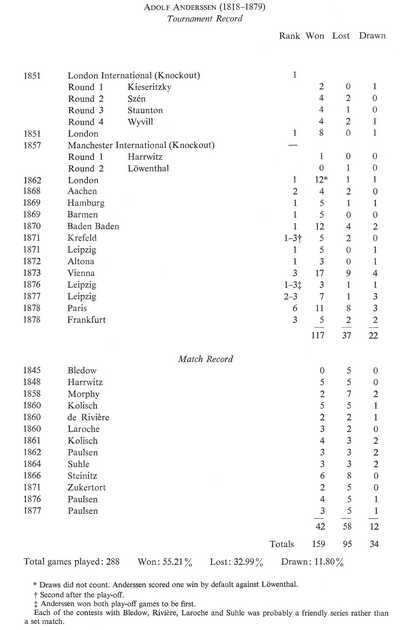
To answer this question I looked at Anderssen's career in Winter's 'World Chess Champions'. Here is the book's summary of Anderssen's record, slightly reformatted to fit into a single image.

Two large tournaments stand out as worthy of further attention. Here are links to their Wikipedia pages:-

  • 1870 Baden-Baden • First was Anderssen, 1.5 points ahead of second place Steinitz. Anderssen beat Steinitz in both of their individual games.
  • 1873 Vienna • According to an unusual scoring system, Steinitz and Blackburne finished tied for first and second, ahead of third place Anderssen. This time Steinitz beat Anderssen in both of their individual games.

Are these events less worthy for consideration as unofficial World Championships than two matches that appear on everyone's list?:-

  • 1872 Steinitz - Zukertort, with a score of +7-1=4; or
  • 1876 Steinitz - Blackburne, +7-0=0

After all...

  • 1866 Steinitz - Anderssen, +8-6=0

...is an 'official' unofficial match, where the score was tied at six each after 12 games. Have later unofficial events been chosen because they best fit the conclusion? If so, chess history has sacrificed consistency in favor of clarity.

***

While I was preparing this post, I noted several points worth mentioning that don't fit easily into the above narrative. Kasparov mentions a match 1868 Anderssen - Zukertort, which is not listed in Winter's book. The chapter on Anderssen was written by G.H.Diggle.

Nearly 20 years ago I used another table from Winter's book in Howard Staunton's Tournament, Match, and Exhibition Record (1840-1866) I was astounded to see that the links to Bookfinder.com still work. I was also astounded to see the prices some booksellers are asking.

What does H.J.R.Murray have to say about this subject. His 'History of Chess' first appeared in the early years of the official World Championship.

16 September 2020

Yekaterinburg Candidates - 2nd Half Announced

Last month I gave up on waiting for news about the continuation of the 2020 Candidates Tournament, and decided to document the tournament situation at that time:-

If I had been a little more patient, I would have seen the official announcement a few weeks later:-

At about the same time, FIDE announced plans for its next Congress:-

The GA will be preceded by five days of online meetings.

09 September 2020

Women's Events 1927-39 : Discrepancies

Continuing with World Chess Championship (Women) : 1927-39 Title Tournaments, in last week's post Women's Events 1927-39 : Players, I built a table showing 'Which players participated in which events' and noted,
I counted nine events and 55 players on the page, across which there are a few items for further investigation. [...] I'll look at the discrepancies in another post.

Since most of the discrepancies were with the names of players, I started by examining Gaige's 'Chess Personalia', but quickly determined that his coverage of early women players was uneven. I switched to Whyld's 'Guinness - Chess - The Records', and was able to complete the task of resolving discrepancies. Whyld has two pages on the early Women's Championship, including eight of the nine events on my own page, which was based on Kazic's 'International Championship Chess'. Only the 1934 Rotterdam match is missing, which Kazic notes was 'not under the auspices of FIDE'.

Whyld spent more effort than Kazic resolving the names of the players across the eight events. On top of that, his book has nearly 40 pages cross referencing almost all of the players listed in 'The Records' portion of the book. After tackling the discrepancies I compared the names given by Kazic against the names given by Whyld and gave preference to Whyld. I ended up with 51 different players in Kazic's nine events.

While I was working on this, I looked at Wikipedia's page Women's World Chess Championship. Its 'List of Women's World Chess Championships' has nine early events all of which lead to a separate Wikipedia page. Those pages for events have good coverage of the participants, usually leading to a separate page for a player. For example, the 1937 Stockholm event has tentative links for all 26 players, of which six are missing, and the 1939 Buenos Aires event has links for 20 players, of which four are missing.

Next step: Add the info for the 51 different players to my page World Chess Championship : Index of Women Players.

***

Later: Re 'Next step', while adding the 51 names to the index, I counted seven who were already listed for having played in a later tournament. I wasn't sure whether one player was the same...

Berea M : 1927-39 Chp
Berea de Montero M : 1952 CT

...so I left both entries for now.

***

Even later: Wikipedia's page Maria Berea de Montero explains,

An Argentine chess Woman International Master (WIM) and women's champion of Argentina in 1951. With the married name of María Angélica Berea de Montero, she participated in the Women's World Chess Championship 1939 in Buenos Aires. She played in several national and South American tournaments, winning the Argentine title in 1951. This let her play in the Candidates tournament of Moscow 1952 and gave her the title of Woman International Master.

The page was created in January 2014.

02 September 2020

Women's Events 1927-39 : Players

In last week's post, Women's World Championship Stalwarts (August 2020), I looked at my World Chess Championship : Index of Women Players, and noticed,
None of the pre-WWII events won by Vera Menchik are included in the counts.

The pre-WWII women's events are all on the same 'World Chess Championship (Women)' page: 1927-39 Title Tournaments. To get started, I built a table showing 'Which players participated in which events' and added it to the 1927-39 page. I counted nine events and 55 players on the page, across which there are a few items for further investigation:-

Ct/Plyr
1 Andersson
1 Andersson,A.
1 Andersson,I.

1 Hermanowa
1 Hermanova

1 Larsen
1 Larsen,I.

9 Menchik,V.
2 Menchik,O.

1 Nakkerud
1 Nakkerund

Also, from the same page: 'Notes for the 1939 Buenos Aires PGN: [...] And Kazic gives Janecek instead of B. Janeckova'

The mention of the Menchiks is not to flag a discrepancy, but to find out more about the less known Menchik. I'll look at the discrepancies in another post.