As before, the asterisk ('*') means the winner is known and the PGN game scores are available. I expect the last three events to be completed by this time next year. As for further events, I have no information.
2.1 The Events shall include the following Competitions (or the same number of events
which may have different Formats or Schedules) during the term of the Agreement, during
each World Chess Championship cycle:
(a) the World Chess Championship Match, every second year;
(b) the World Chess Challenger competition (also known as the Candidates
Tournament), alternating with the World Chess Championship, every second year;
(c) six Grand Prix competitions or their equivalent, as may be agreed between
FIDE and Agon from time to time, are spread out over the two year cycle;
(d) the World Cup competition held in 2015 and each second year thereafter;
provided that the World Cup competition shall only be a "Competition" hereunder if (i)
FIDE has used its best efforts to bundle that and subsequent World Cup and Chess
Olympiad with a single sponsor; and (ii) FIDE has notified Agon no later than 18 month prior
to the start of the calendar year in which the World Cup is to take place that it has failed to
find such a sponsor. For any World Cup that is not a "Competition" hereunder, Agon will
remain available to provide full marketing and branding support for this event, as specifically
provided for in this Agreement, as with all the other Competitions provided that there are
no branding and sponsorship conflicts;
(e) any other competition that offers or assures the winner a place in the World
Chess Challenger competition; and
(f) such additional competitions ("Additional Competitions") as may be
designated as Competitions by Interface Resolution from time to time.
In short, Agon will be responsible for the World Championship title match, the Candidates event, and the Grand Prix. Should FIDE be unable to bundle the World Cup with the Olympiad, the World Cup will be included. An entire cycle will take place over two years instead of the haphazard scheduling we've seen over the last few cycles.
I had hoped to document the final Grand Prix standings on that 2011-12 WGP page, but was unable to find them. The official site,
grandprix.fide.com,
currently lists only the totals through the fifth event, Jermuk 2012. If you're not sure what happens next in the Women's World Championship, see my post on the fifth event,
2011-2012 Women's Grand Prix, Jermuk.
***
Later:
Following up a subsequent idea, outlined in
2015-2016 Women's Grand Prix, the Players
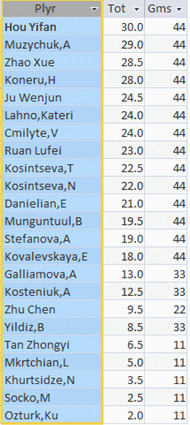
(December 2016; 'The first two posts, 2009-2010 & 2011-2012, could use a chart like the one shown above.'),
I added the chart shown on the left.
For each of the players who competed in the 2011-2012 Grand Prix, it shows the total score achieved and the number of games played by the player.
I added the crosstable and PGN for the 2012 London event to my page on the
2012-2013 Grand Prix.
The first event of the second Grand Prix (GP) series came almost four and a half years after the first event, 2008 Baku, of the first GP series,
2008-2009 Grand Prix.
Will the second GP series manage to dodge the many bullets that crippled the first? Time will tell, but FIDE and its sponsor Agon are certainly off to a good start.
I added the Ankara event to my page on the
2011-2012 FIDE Women's Grand Prix.
Coming only two months after the
2011-2012 Women's Grand Prix, Jermuk
tournament, this was the last of the six events in the current series. I haven't seen the final official standings for the entire series, but Fide.com says,
Humpy Koneru became a winner of sixth stage of the FWGP in Ankara and placed second in the overall Grand Prix series after Hou Yifan. The Chinese has already clinched the first place in the overall Grand Prix cycle.
As soon as I see the final results for all competitors, I'll add it, and will also update the
Index of Women Players.
The link to the series of Youtube videos that I noted in
83rd FIDE Congress
isn't the only video resource available for that gathering. It turns out that the same camera man, Sevan Muradian, has extracted some of the most important sequences to separate videos. For example, below is a clip covering Andrew Paulson's appearance in front of the General Assembly.
If you're not familiar with Paulson, he's the white knight to whom FIDE has given the contract for the next few World Championship cycles. I covered his swift ascent to FIDE center stage in two recent posts:
Evolution of a Press Release
and
C25 Candidates & C26 Grand Prix.
Agon (47:27) • 'Published on 19 Sep 2012 by North American Chess; no description available'
Although the clip is over 47 minutes long, Paulson's main presentation lasts for only three minutes near the beginning. Here's a highlight:-
I'm often asked by journalists, do I really think that I can make chess as big as it was 20 or 30 years ago, and I point out to them that chess is bigger than it was 20 or 30 years ago. It's simply that media attention -- the eye of the camera -- has been elsewhere. So in fact a major part of our strategy is to bring back media attention to the events themselves. It's not a major transformation. I don't have any revolutionary ideas. I simply plan on doing everything a little bit better and I think that's the core of our plan.
The rest of the video is a Q&A featuring various FIDE heavyweights, epsecially FIDE Deputy President Makropoulos. FIDE President Ilyumzhinov remains silent throughout. My favorite segment is an exchange between Paulson and Vice President Ilya Levitov, who also happens to be President of the Russian Chess Federation, on the withdrawal of the Chelyabinsk organizers from the first Grand Prix event, which was hastily reorganized in London.
Another portion worth excerpting is Paulson's response when asked about 'media channels' at the London Grand Prix:-
The first two Grand Prix's, which were supposed to be in Chelyabinsk and Tashkent, we had no major plans for innovation. We signed the contract six months ago and there was still an amount of uncertainty around it. Our plans are to make a big, let's say, a transitional moment during the Candidates which will also be in London in March.
Toward the end of the video, Makropoulos explains the importance of the contract to FIDE:-
I'm proposing to approve this contract, because it's very important for FIDE at this moment. It's the first time in our history to have our events for the World Championship cycle, very expensive events; it's the first time in our history to have someone who can guarantee these events.
If you are also interested in the CNC presentation, which preceded the Agon time slot, see
CNC,
on the same Youtube channel.
While writing yesterday's post on my main blog,
The Match That Never Was,
I had a vague recollection of another fabricated Fischer - Karpov game from a few years ago. Sure enough, I found it on Chessbase.com and added the relevant links to the 'Never Was' post.
One unfabricated fact about the game didn't seem right: that the main negotiations between Fischer and Karpov occurred in the Philippines. The one reference by Chessbase -- Russians vs. Fischer, by Plisetsky and Voronkov (1994), p.366-367 -- mentions only meetings in Tokyo and Cordoba. Then I turned to Kasparov's volume on Fischer, My Great Predecessors IV, where starting on p.467, there is a long, detailed account titled 'Abdication'. Here is a timeline derived from that account.
1972-09
•
Reykjavik: Fischer wins title from Spassky
1972
•
San Antonio: Fischer visits tournament; meets Karpov for first time

 Later:
Following up a subsequent idea, outlined in
Later:
Following up a subsequent idea, outlined in
 While writing yesterday's post on my main blog,