27 February 2019

Index of Women Players

In last month's post, Small Projects for 2019, I wrote,
As part of preparing the first post of this current month, 2018 Women's World Championship PGN, I routinely 'added the names of all 64 players to the Index of Women Players'. While doing that I noticed several inconsistencies across the index and will address those as soon as I can.

The action resulted in around a dozen changes to the referenced page, most of which aren't worth mentioning. I did, however, correct two misspellings.

On the page for the 1961 Candidates Tournament (Vrnjacka Banja, X-XI, 1961), I had the name 'Hundsuren' instead of the correct Sandagdorj Handsuren (wikipedia.org). On the page for the 1967 Candidates Tournament (Subotica, IX-X, 1967), I had 'MacGrath' instead of Marion Mott-McGrath (ditto).

The page Index of Women Players now has 463 names for a total of 1338 cross-references to other pages on the site. I had a relatively easy time finding the info I needed to make the corrections. Twenty years ago, when I first started creating the main page, World Chess Championship for Women, there was almost nothing about the subject on the web and I relied on offline resources to construct the framework.

20 February 2019

FIDE Maps the New Cycle

After four consecutive posts on the World Championship in the 19th century, let's return to the 21st century, last seen in 2018 FIDE Congress : Whither the World Championship? (January 2019). After the 89th Congress, FIDE went quiet for a few months as the new management deliberated on the future of the organization. Since the beginning of 2019, they have issued a flurry of announcements about upcoming events. Let's start with the master plan for the current cycle, which is just starting.
  • 2019-02-18: Road to Candidates • 'Qualification system for the 2020 FIDE Candidates Tournament'

    A. 1 place – 2018 FIDE World Championship Match, Runner up
    B. 2 places – 2019 FIDE World Cup
    C. 1 place – 2019 FIDE Grand Swiss Tournament
    D. 2 places – 2019 FIDE Grand Prix Series
    E. 1 place – Highest Average FIDE Rating (Feb. 2019—Jan. 2020)
    F. 1 place – Player nominated by the Organizer

That makes eight places in the Candidates tournament and three qualifying events, one of which is brand new:-

The Grand Prix received a complete makeover:-

For the corresponding World Chess announcement, see Guide to the 2019 Grand Prix Series (worldchess.com). The World Cup continues in the same format that we've seen since 2005:-

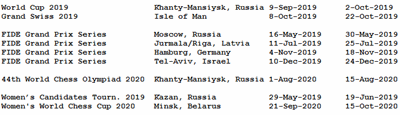
The FIDE Calendar (fide.com), currently shows the following World Championship events. I include the 2020 Olympiad as a reminder that most other 2020 events are not yet listed.

I also set up place holders for the current cycle on my The World Chess Championship index page. When was the last time we had three qualifying events for the Candidates tournament?

13 February 2019

1851 London (the Tournament Books)

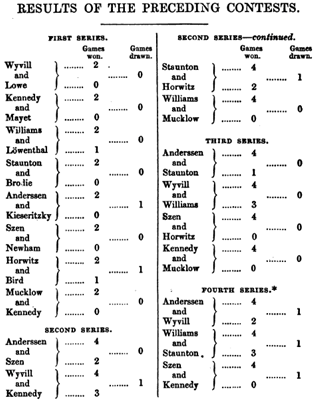
In my previous post, 1851 London (on Google Books), I referenced a digital copy of Staunton's book 'The Chess Tournament', his account of 1851 London, the first international tournament. Page 174 of the book gives a summary of the matches.

I compared this against my own page on the matches, 1851 London Tournament; London, V-VII, 1851, and except for a slight problem with one name ('Lowe' vs. 'Loewe E') the basic info was the same. The same page in the book includes a note:-

In this final section, the match between Anderssen and Wyvill was to decide which took the First, and which the Second Prize. The next contest, between Williams and Staunton, was to determine which took the Third, and which the Fourth Prize. The third encounter, between Szen and Kennedy, was to decide who took the Fifth, and who the Sixth Prize ; and the Fourth Match, between Horwitz and Mucklow, was to settle their respective right to the Seventh and Eighth Prize. (This match not being played, in consequence of Mr. Mucklow's absence, the Committee adjudged Mr. Horwitz entitled to the Seventh Prize, and awarded the Eighth to Mr. Mucklow.) It is to be regretted that, owing to the arrangements, which were unavoidably adopted to shorten the duration of the Tourney, most of the chief players, as Kieseritzky, Szen, Staunton, Loewenthal, Mayet, &c., were precluded from contesting at all for the Second Prize.

That last sentence is curious and indicates that the organizers were not happy afterwards with the tournament's knockout format. Starting with the first round all of the players were paired unseeded.

In that previous post I also referenced a digital copy of the German edition of the tournament book. It turns out that the German version is not a straightforward translation of the English version. It includes ten new pages of introductory material for which Google Translate gives the following as the first sentences of the anonymous 'Forward':-

From the following treatment of the Chess Tournament, the German reading world may be assured that not only all factual and historical facts about the great chess tournament, but also the merely reflecting part of its contents, wherever a clear view guides the hand of the author has, faithfully and completely reproduced. But it must be sincerely known that one believes in terms of the effusion of a cranky vanity and bitterness against alleged contraindications -- a substance to which the famous author attributes only too much space in his mind, as in his book has to deal with the patience of the local audience with care. Regardless, too many of the persistent or hateful ones have been taken up by Staunton's hand. This, however, was not to be avoided partly for the constancy of great injustice and inconvenience, partly in favor of the connexion and the psychological interest.

The German player Anderssen won, while the English player Staunton only finished fourth. Although that translation is far from perfect, the rest of the introduction is worthy of a similar treatment.

06 February 2019

1851 London (on Google Books)

Last week, in 1862 London (on the Web), I used the six-page bibliography in Gelo's book 'Chess World Championships' to locate source material for the referenced tournament. Another bibliographic entry serves a similar purpose:-
Staunton, Howard. The Chess Tournament. London, 1852.

There are several scans of this book in Google Books. The first copy I downloaded had large sections of the book out of sequence, so I located a better copy:-

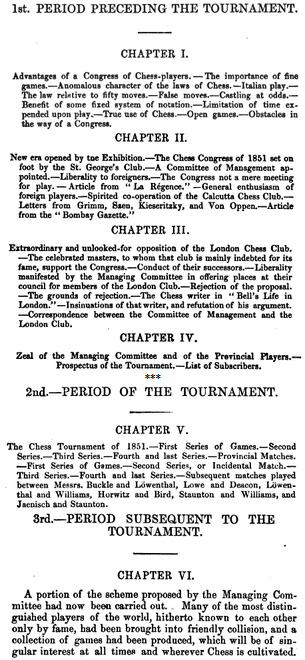
The first 90 pages of the book are Staunton's own account of the tournament. The rest of the book (the 382 pages mentioned in the book's description) contains the moves of the games plus light annotations by Staunton. To help me find my way around Staunton's account, I constructed the following table of contents.

Also on Google Books are two related works from the 19th century:-

Staunton's edition was published again toward the end of the 20th century:-

How close are these to the original? Google Books doesn't offer a digital copy.

30 January 2019

1862 London (on the Web)

This month marks 20 years since I first uploaded my World Championship page for the 1862 London Tournament. How well has it withstood the test of time?

In last week's post, Acknowledging an Important Source, I noted the importance of Gelo's book 'Chess World Championships' as a reference for many of the pre-1883 pages on my site. The book is documented by a six-page bibliography including an entry for:-

Loewenthal, J., ed. The Chess Congress of 1862. London, 1889.

A digital copy of the book is available online via a Google Books page, The Chess Congress of 1862, subtitled, 'A Collection of the Games played, and a Selection of the Problems sent in for Competition. To which is prefixed an Account of the Proceedings and a Memoir of the British Chess Association. By G. W. Medley'. This book is undoubtedly the source for much that is known about the event.

Wikipedia has a page, London 1862 chess tournament, that dates back to October 2008. Its source was London 5°Congresso Britannico, 16/6 - 2/8 1862 (archive.org // xoomer.alice.it). Both references use the same technique to indicate draws that were replayed, and neither shows which games were forfeits.

The most recent incarnation of the event is probably on the Zanchess blog: London 1862 – Preliminary results and xtabs (January 2016; 'There were 91 decisive games, of which 21 were forfeits; two decisive games are missing.'; see comments, esp. 'ckr') and London Chess Congress 1862 – a first-look look (February 2018). The forfeited games are not indicated here either.

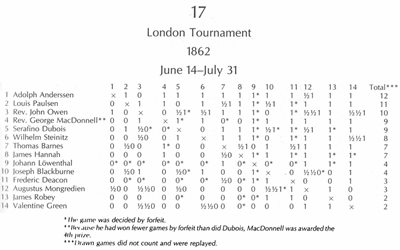
If the forfeited games were handled as they are in modern times, Loewenthal's record in the event would be excluded. He scored +3-0 (+1F-9F) for a total of 10 forfeits out of 13 games.

23 January 2019

Acknowledging an Important Source

The first point I want to tackle from my previous post, Small Projects for 2019, is:-
In December I received an email asking for clarification about certain points related to my page, 1862 London Tournament.

For reference, here's the link to the page: 1862 London Tournament (m-w.com). The essence of the email was the following exchange:-

Q: What was the source of your crosstable? Do the forfeited games [in the PGN file] indicate black forfeited all of them as the result indicates or is it just a listing of games not played? • A: The files you mention were created in January 1999. The source was Gelo's 'Chess World Championships 1834-1984' (McFarland 1988). The forfeits are indicated in the book without showing color; it was my choice to build the forfeit file by assigning the win to the first named player.

For further reference, the most recent edition of the book is available on Amazon.com, Chess World Championships by James H. Gelo, subtitled 'All the Games, All With Diagrams 1834-2004. Two Volume Set. 3rd Edition'. The copy I worked from 20 years ago was the 'Second printing, corrected (1995)'.

While I was researching the email, I realized that I had never acknowledged the source of my page for 1862 London. Here's a copy of the tournament crosstable given in Gelo's book (chapter 17), slightly reformatted.

This crosstable is more informative than mine, because it indicates all the draws and forfeits played in the tournament. I build all of my crosstables by collecting the games in PGN format, generating a crosstable from the PGN, and checking the generated crosstable against another source. The earliest events were checked against Gelo. I'll try to establish which ones in a follow-up post.

16 January 2019

Small Projects for 2019

After two and a half months of blog posts about the latest World Championship events...

...it's time to move on to other topics. While I was watching those events, I developed a list of other ideas to cover as soon as time permitted. The last time I did this, Small Projects for 2018 (December 2017), it turned out to be a useful roadmap for preparing several subsequent posts. The first two of the actions on that 'Projects' post are still open:-

  • 2017-02-22: Missing Months
  • 2017-06-07: Zonal Qualifiers C01-C12 : Archive.org

That first action is ongoing, while the second required permission to reuse published material. This permission was granted recently: 'If you'd like to quote my zonal material, that's fine.'

As for other projects, in December I received an email asking for clarification about certain points related to my page, 1862 London Tournament. While I was looking into the questions I realized that they were related to a recent post on my main blog, World Championships in London (November 2018). The history of the World Championship in the 1840s-1880s, a period spanning nearly 50 years, was centered on London. That important era deserves a closer look.

Another aspect of 'Championships in London' was the renewed interest for the English city in 1983, after lying dormant for exactly a century. That story deserves at least one post, perhaps more.

As part of preparing the first post of this current month, 2018 Women's World Championship PGN, I routinely 'added the names of all 64 players to the Index of Women Players'. While doing that I noticed several inconsistencies across the index and will address those as soon as I can. As for refreshes to existing material, I have to spend some time on:-

The first of those topics was last addressed in:-

The second was addressed in:-

If I manage to get all of that done, there's always a backlog in:-

That's my category for keeping track of follow-ups. There are currently 23 posts in the category, most of them non-trivial.