Last week's post was about the
1998 Karpov - Anand FIDE Title Match.
The post,
Chess Heaven in Lausanne
(March 2023), was based on Elizabeth Karnazes's report in the March 1998 issue of
Chess Life.
Summarizing the report at the end of the post, I noted,
The entire piece was more about the ambience surrounding the event.
[...]
As good a story as it was, I'll try to add a post that focuses more on the chess played in the match.
This current post is based on 'Le jeu d'Echecs vers l'Olympe' (English: 'Chess on Olympus') by Christophe Bouton, the introduction to a 16-page report that appeared in the February 1998 issue of Europe Echecs.
Just like I did in
Sanghi Nagar: The Kamskys vs. the World
(March 2023), I'll use Google Translate together with my high school French to understand the report.
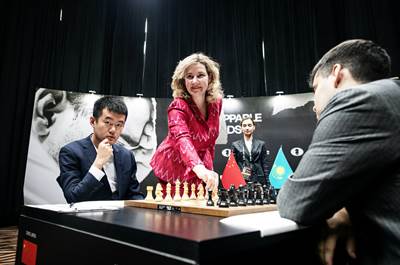
It used the following photo at the top of the first page.
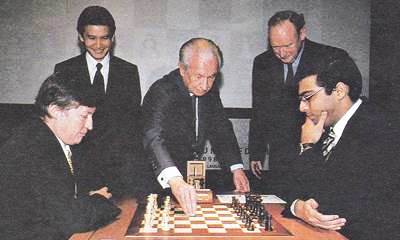
The photo didn't have a caption. If it did have, it might have been something like this:-
At the board:
Karpov (left), Anand (right)
•
Behind the board: (left to right)
FIDE President Kirsan Ilyumzhinov,
President of the International Olympic Committee (IOC)
Juan Antonio Samaranch,
Match Arbiter Geurt Gijssen
•
Photo:
SIPA/Sichov
The report started,
Suffocated by a hug from his French representative, Jean-Paul Touzé, at the end
of his victory in the second game of the
tiebreak, Anatoli Karpov finally relaxes.
Head bowed, he immediately takes refuge
with a few members of his team in the
three-meter-squared box which served as a relax room during the match, on the side of the hall of the
Olympic museum where he faced the Indian
Viswanathan Anand for a week.
And he cries.
That's not the behavior one normally imagines from the winner of a world class competition, and Bouton's article was no normal report.
Why did Karpov cry? Because, 'The tension was too great.'
And Anand?
At the other end of the room, Anand sports
a strained smile. His dream came crashing down
in just over a hundred minutes [for both tiebreak games]. His wife
Aruna is at his side and does not stray far.
He responds mechanically to timid
questions and slips away discreetly so as not
to be bothered by many fans,
disappointed and sad.
From the above excerpts, we can be cetain that Bouton was an eye-witness to the match.
From Karnazes's report we also know that there was a side-event for journalists without chess titles, in which she played.
According to EE, in a small box attached to the full report, Bouton won the event and pocketed US$ 9000 offered by 'His Excellence' Ilyumzhinov. Bouton's understanding of current chess events permeated paragraphs like the following.
But is Karpov really champion
of the world? Anand fans doubt it,
the best players in the world laugh at it,
the numbers speak: to qualify for
Lausanne, Anand played 23 games and
eliminated six of the best players in the
world. Meanwhile, Karpov
was preparing in peace, because he was
directly qualified.
He and Kasparov were to
enter the semi-finals. Kasparov did not
follow up, as expected. And Karpov
dug in behind the leonine
[one-sided?; inequitable?]
clause which
stipulated that if one of the two "K"s did
not play, the other went directly to the final.
With this victory thanks to
semi-rapids -- because finally in long games, Karpov drew 3-3 against
Anand (two wins and two losses each) --
Karpov, sixth player in the world in the January international ranking, is champion
of the world until the year 2000.
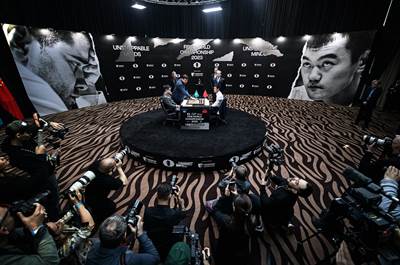
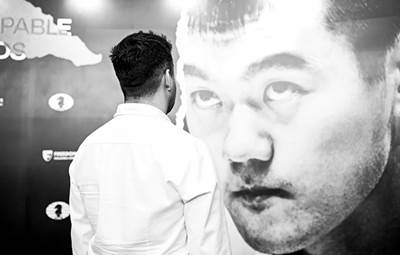
Bouton's two-page report, including more photos from the same photographer featured above, was followed by annotations of all games, three of them with detailed notes by GM Joel Lautier, who was ranked French no.1 (World no.28) at the time.
I have access to about 35 years of Europe Echecs and it might be useful to inventory the many other world class events covered by the magazine.